Goodbye, 2021. We won’t focus on the way you left us — dealing with a new COVID-19 variant and uncertain about the future. No, we at Washington University will focus on the good — bold new discoveries, hopeful new students and a promising new direction for the university.
From the South 40 underpass to the highlands of Peru, Washington University’s top videos take viewers across the globe to showcase amazing students and groundbreaking research. Here, the Source shares the seven most-viewed videos of 2021.
Nominations are being accepted for Washington University’s annual Faculty Achievement Awards, known as the Arthur Holly Compton Faculty Achievement Award and the Carl and Gerty Cori Faculty Achievement Award. The nomination deadline is Feb. 11.
A new study by researchers at Washington University School of Medicine and St. Jude Children’s Research Hospital helps explain why mRNA vaccines have been so successful at preventing severe disease.
January 6, 2022, marks the one-year anniversary of the attack on the U.S. Capitol building by supporters of president Donald Trump. Here, university experts in political science and law offer their thoughts on what the attack means.
Researchers at Washington University School of Medicine are working to develop new treatments for two types of devastating parasitic infections common in sub-Saharan Africa and Central and South America: river blindness and intestinal worm infections.
Work from the lab of Rohit Pappu at the McKelvey School of Engineering and colleagues at St. Jude continues to reveal novel findings about phase separation, the process cells use for organization.
Longtime St. Louis benefactor Joanne Knight has committed up to $11.5 million to Washington University School of Medicine in St. Louis to support an innovative clinical trial aimed at preventing Alzheimer’s disease by treating people before the first signs of the illness appear in the brain.
Researchers at Washington University School of Medicine are conducting an Alzheimer’s prevention trial with young adults from high-risk families to evaluate whether an investigational drug can clear a key Alzheimer’s protein, amyloid beta, and slow or stop the disease.
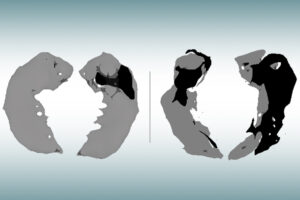
Scientists at Washington University in St. Louis described for the first time the structure of a bifunctional protein, called CcsBA, that transports heme and attaches it to cytochromes. The study led by Robert Kranz, professor of biology in Arts & Sciences, captured two conformational states of CcsBA, a bacterial and chloroplast protein, allowing researchers to characterize the enzyme mechanism.