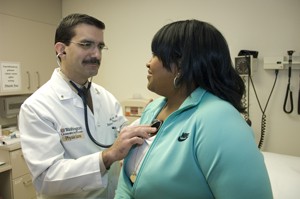
A drug commonly used for the treatment of chronic obstructive pulmonary disease (COPD) successfully treats adults whose asthma is not well controlled on low doses of inhaled corticosteroids, says a new study.
A strong work ethic and the importance of family has fueled Terrie E. Inder’s passion for determining the impact of premature birth on brain injury and development in the Neonatal Intensive Care Unit at St. Louis Children’s Hospital.
Kevin Washburn, JD, professor and dean of the school of law at the University of New Mexico, will deliver a talk on “Improving Criminal Justice for American Indians,” at noon Thursday, Sept. 23, for the Assembly Series. The program, which is free and open to the public, will be held in the Bryan Cave Moot Courtroom in Anheuser-Busch Hall.
Washington University installed automatic external defibrillators (AEDs) in seven areas across the Danforth Campus Sept. 16 with a high volume of foot traffic. An AED is a computerized medical device that can monitor a person’s heart rhythm and can recognize when a distressed person requires a shock to re-establish a normal heart rhythm.
A search is under way to fill a new vice provost position in the Office of the Provost whose initial focus will be on diversity and faculty development, among other areas of university-wide importance. An advisory committee has been formed that will identify and recommend candidates from within the Washington University community.
Missouri has one of the highest statewide smoking averages in the country, more than 23 percent. And racial and ethnic minorities, people with lower incomes and education levels, Medicaid recipients and the LGBT community smoke or experience secondhand smoke at a rate significantly higher than the state average.These findings are highlighted in a new report by the Center for Tobacco Policy Research (CTPR) at Washington University in St. Louis. The report, “Who is Most Affected? Tobacco-Related Disparities in Missouri,” identifies statewide differences related to who is smoking, who is exposed to secondhand smoke and who is quitting.CTPR is offering a media-only webinar on the new disparities report at 10 a.m. Tuesday, Sept. 21. Researchers will discuss the report and be available to answer questions about the findings. Visit https://www3.gotomeeting.com/register/895612886 to register. More information about CTPR’s report is available at: http://news.wustl.edu/news/Pages/21180.aspx
.ExternalClass p.MsoNormal, .ExternalClass li.MsoNormal, .ExternalClass div.MsoNormal
{margin:0in 0in 0.0001pt;font-size:12pt;font-family:’Times New Roman’;}
.ExternalClass a:link, .ExternalClass span.MsoHyperlink
{color:blue;text-decoration:underline;}
.ExternalClass a:visited, .ExternalClass span.MsoHyperlinkFollowed
{color:purple;text-decoration:underline;}
.ExternalClass div.Section1
{page:Section1;}
Of note Gautam Dantas, PhD, assistant professor of pathology and immunology, has received a two-year, $75,000 grant from the National Academies Keck Futures Initiative for research titled “Functional Metagenomic Discovery of Novel Enzymatic Functions from Ultra Low-Volume Samples with Whole Metagenome Amplification.” … Kavit Alan Desouza, MD, research scientist in biomedical engineering, has received a […]
The Daily Telegraph (UK) Gene predicts speed of Alzheimer’s development 9/17/2010 Knowing that certain patients are going to develop the disease very quickly could also help experts better analyze the effectiveness of trial drugs designed to slow its development, suggests a WUSTL study. “We have looked at data from three separate, international studies, and in […]
An international team of Alzheimer’s disease experts, led by Washington University School of Medicine in St. Louis, has uncovered a gene variation that appears to predict the rate at which Alzheimer’s disease will progress. Whereas previous studies have focused on factors that influence the risk for developing Alzheimer’s, the new research points to a way to determine how rapidly the disease will progress.