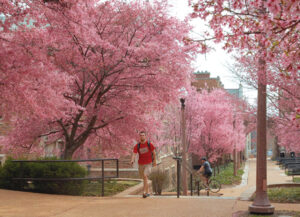
Home to approximately 3,800 trees, the Danforth Campus of Washington University in St. Louis was recently recognized by the Arbor Day Foundation as a Tree Campus USA. Bald Cypress, Valley Forge Elm, Gingko, Swamp White Oak and Tulip Poplar are among the 46 different tree species and 76 varieties on campus.
The Alumni Association hosts hundreds of events around the world that reunite alumni and reinforce their connection to the university. Recently, alumni gathered in Florida to watch St. Louis Cardinals spring training games.
Jeremy Friedman, AB ’09; Ryan Hwang, BSBA ’09; and Timothy Trinidad, BSBA ’09, found that social networking helps keep the kids focused on their studies. That’s the philosophy behind their “web-based learning management system,” Schoology.com.
Sheryl Grossman, AB ’98, MSW ’00, who has Bloom’s Syndrome, a rare genetic condition characterized by short stature and a predisposition to multiple secondary conditions, founded Bloom’s Connect, the only international support group for people with Bloom’s Syndrome.
School of Medicine students rehearse for the School of Medicine spring musical, “Curtains,” to be held at 7:30 p.m. April 14-16 at the Whelpley Auditorium on the St. Louis College of Pharmacy campus. Tickets may be purchased beginning Monday, April 4, in Room 100 of the McDonnell Medical Sciences Building or in the Farrell Learning and Teaching Center lobby from noon-1 p.m. daily.
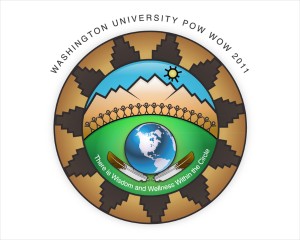
The 21st annual Pow Wow at Washington University in St. Louis, a festival of American Indian cultures, will be held Saturday, April 9, in the Field House. This event, hosted by the Kathryn M. Buder Center for American Indian Studies at the Brown School, is free and open to the public. Visitors and participants will be able to enjoy dancing, singing, drumming, arts, crafts and food. Intertribal and contest dancing take place at 1 p.m. and 7 p.m. Traditional arts and crafts booths and community information booths open at 10 a.m.
Steve Sobo, director of design and construction, at the School of Medicine, oversees construction of new buildings and remodeling of existing facilities. His relaxed, direct communication style helps his projects go smoothly. “There’s a frank friendliness about Steve,” says Jim Walsh, a principal at Cannon Design. “He has an ability to bring together individuals to get a job done, and he also charts a clear, concise path.”
Bruce A. Carlson, PhD, assistant professor of biology in Arts & Sciences, has received a three-year, $581,304 grant from the National Science Foundation for research titled “Synaptic Mechanisms for the Processing of Temporal Codes.” … Joseph Corbo, MD, PhD, assistant professor of pathology and immunology and of genetics, has received a two-year, $100,000 grant from […]
Three Washington University in St. Louis faculty members are being honored this month by the Academy of Science of St. Louis: Marcus E. Raichle, MD; Timothy Eberlein, MD; and Linda S. Cottler, PhD. The mission of the academy is to “foster the advancement of science and encouragement of public interest in and understanding of the sciences.” The awards will be given Wednesday, April 13, at a dinner at the Chase Park Plaza Hotel.
WUSTL Dining Services has introduced a reusable to-go box, which can be used at any WUSTL Dining Services location on the Danforth Campus. The box, which is available for $3, allows faculty, staff and students to take their meal to-go without using a cardboard to-go box. Diners who use the box receive a 25-cent discount on each meal purchased with the box.