Luis Zayas’ commitment to U.S. Latinas and their struggle with suicide started in the 1970s when he encountered the pain and suffering that the teenage girls and their parents were experiencing during his work in emergency rooms and mental health-care clinics. “Latinas have the highest rate of suicide attempt among teens in comparison to white girls or African-American girls,” says Zayas, PhD, the Shanti K. Khinduka Distinguished Professor of Social Work at the Brown School at Washington University in St. Louis. Zayas brings compelling personal stories and nearly 40 years of research to his new book, Latinas Attempting Suicide: When Cultures, Families and Daughters Collide, published by Oxford University Press.
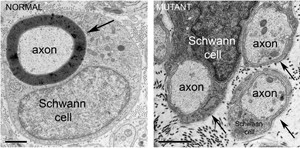
The body’s ability to perform simple tasks like flex muscles or feel heat, cold and pain depends, in large part, on myelin, an insulating layer of fats and proteins that speeds the propagation of nerve cell signals. Now, scientists have identified a gene in mice that controls whether certain cells in the peripheral nervous system can make myelin. Called Gpr126, the gene encodes a cellular receptor that could play a role in diseases affecting peripheral nerves.
This year’s Eliot Society Search Award was given to Sima and Philip Needleman for their extraordinary dedication to Washington University. The award was given May 11 at the Ritz-Carlton Hotel in Clayton, Mo. “This year’s Search awardees, Philip and Sima Needleman, have an enduring association with Washington University, and have served the institution in many important ways,” Chancellor Mark S. Wrighton says. “It was a pleasure to acknowledge their significant and lasting contributions.”
Faculty, staff and students who wish to park vehicles on the Danforth Campus during the upcoming 2011-12 academic year must renew their parking permits. Permits for the 2010-11 academic year expire Thursday, June 30. Permits can be renewed online at parking.wustl.edu or at the Parking and Transportation Services office in North Campus.
Graduating senior Frances Fei and her father drop off a TV and other items for donation to the Share Our Stuff (SOS) “Lightening Your Load” event May 21 at the Academy Building. At the event, WUSTL students in the process of moving out and other community members could donate unneeded items to Goodwill rather than throw them away.
In her 32 years at the School of Law, Beverly M. Owens has supported the education and research endeavors of thousands of law faculty members and students. In recognition of her hard work and dedication, Owens, assistant director for faculty support in the law school, was recognized with the Gloria W. White Distinguished Service Award in a May 23 ceremony in Edison Theatre.
With the email of Wednesday, June 8, Washington University in St. Louis presents a redesigned Record, the official faculty and staff electronic publication of the university. Changes include a redesign of the Record email that includes links to regular Record features such as Washington People, Obituaries and Sports. It also includes redesigned features such as Notables and In the Spotlight, and a WUSTL in the News section with links to university stories on a national level.
WUSTL finished third in the 2010-11 Learfield Sports Directors’ Cup Division III standings. The third-place finish is the second-highest in school history and the Bears’ ninth-straight top 10 appearance. Points are awarded based on each institution’s finish in up to 18 sports — nine women’s and nine men’s. Other updates include honors for the women’s track team members Liz Phillips and Taryn Surtees; and the announcement of the freshman football class of 2015.
Ozioma (localhealthdata.org) is a new online tool from the Health Communication Research Laboratory (HCRL) at Washington University in St. Louis designed to increase the amount of locally relevant health information in communities through media. Ozioma, which launches June 8, allows users to search for health data from the U.S. Department of Health and Human Services (for example, National Cancer Institute and Centers for Disease Control and Prevention) and more than 60 other reliable sources — all in one place.