A survey of tanning salon operators in Missouri shows that 65 percent would allow children as young as 10 to 12 years old to use tanning beds. That’s despite evidence that any tanning bed use increases the risk of all skin cancers, including melanoma, the deadliest form of skin cancer, later in life.
Several new faculty members have joined the Olin Business School. Their expertise covers various areas, such as accounting, communications, finance and marketing.
Jewish families in the WUSTL community are encouraged to consider hosting a student for Passover. St. Louis Hillel seeks families to open their homes and share a warm, home-away-from-home Passover experience with students. To participate, hosts and students must register by March 20.
p, ,
{margin:0in;margin-bottom:.0001pt;font-size:12.0pt;font-family:Cambria;}
div.WordSection1
{page:WordSection1;}
The Washington University military care package group has been sending snacks, sporting goods, toiletries, baked goods and other needed items to the troops in Iraq and Afghanistan since March 2004. The deadline to make contributions to the next mailing is Wednesday, March 20 at 10:30 a.m.
Many WUSTL students will be on hand at the St. Louis Science Center this Saturday from 10 a.m. until 4 p.m. to explain the brain and their brain research to interested visitors. They are participants in NeuroDay, a free brain science expo featuring hands-on
activities and demonstrations that provide a rare opportunity to learn
about the human brain, the nervous system, neurological disorders and
cutting-edge brain research.
With their intricate textures, subtle surface variations and visible reworkings, Georges Braque’s midcareer paintings demonstrate a profound interest in the painting process and in the possibilities of his materials. Patricia Favero, associate conservator for The Phillips Collection in Washington, D.C., will discuss Braque’s technique, in conjunction with the exhibition Georges Braque and the Cubist Still Life, 1928-45.
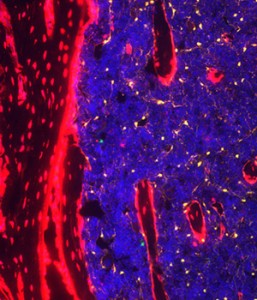
In research that one day could improve the success of stem cell transplants and chemotherapy, scientists have found that distinct niches exist in the bone marrow to nurture different types of blood stem cells.
A large team of scientists has decoded the genome of a sea lamprey – one of the few ancient, jawless species of vertebrates that has survived through the modern era.