Nearly one in four people living in the City of St. Louis lives in poverty and faces hunger, and local food pantries across the region have experienced a 30 percent increase in requests over the last year. For the third year, Washington University is partnering with Operation Food Search to coordinate the PB&Joy University-Wide Food Drive, which runs April 4-16.
In the political realm, climate change remains a point of debate. But for those charged with managing its effects — the storms and floods followed, whiplash style, by drought and water scarcity — the evidence is in. From March 22-25, the Sam Fox School of Design & Visual Arts and The Royal Netherlands Embassy in Washington, D.C., will present MISI-ZIIBI: Living with the Great Rivers, an international symposium investigating climate adaptation strategies in the Mississippi and Missouri basins.
If American war films are characterized by large-scale combat and appeals to valor, French war cinema is arguably more intimate and psychologically driven. From March 19-21, the Mildred Lane Kemper Art Museum will present three iconic films as part of its France at War Film Series.
At polling places across America in November 2012,
Latinos and African Americans under age 30 were disproportionately asked
for identification, even in states that do not have voter ID laws,
according to a post-election analysis by researchers at Washington
University in St. Louis and the University of Chicago.
The eighth annual African Film Festival at Washington University in St. Louis will feature award-winning African films and filmmakers March 22-24. Organizers say the festival exposes the St. Louis community to “African stories as told by Africans,” helping to dispel stereotypes about Africa. All film showings, which are free and open to the public, take place in Brown Hall, Room 100, on the university’s Danforth Campus.
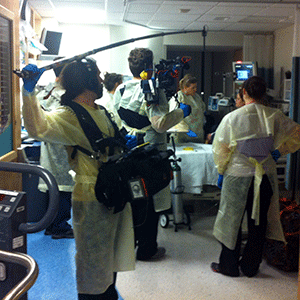
A documentary-style series highlighting patients, faculty physicians and other staff at St. Louis Children’s Hospital will debut Saturday, March 16, on KSDK. “The Frontline for Hope” will air Saturday nights for the next six weeks. Shown is one of the camera crew taping outside the hospital.
A new food-service area on the north campus of Barnes-Jewish Hospital will open at 6 a.m. Wednesday, March 13. It will replace the Kingshighway Building’s north cafeteria, which will close permanently Tuesday evening, March 12.
Sleep is disrupted in people who likely have early
Alzheimer’s disease but do not yet have the memory loss or other
cognitive problems characteristic of full-blown disease, researchers at
the School of Medicine report. Shown is first author of the study, Yo-El Ju, MD, an assistant professor of neurology.
“SPIN-IT: A Leadership Program for Women in IT” is accepting applications. The new program aims to encourage and support women, both staff members and students, pursuing careers in information technology. The deadline for staff members to apply is Friday, March 15; the deadline for student applications is March 22.
Zachary Hernandez, a Mellon May Undergraduate Fellow in Arts & Sciences, explains his research on “Navigating Public Transportation in Bogota, Colombia” during the Association of Latin American Students’ 8th annual symposium on Latino contributions, held Feb. 20 in the Danforth University Center. Co-sponosred by the Annika Rodriguez Scholars Program, the event featured 15 submissions ranging from artwork to research projects related to Latino and Latin American culture and society by WUSTL students.