Director John Waters calls Home Movie Day “an orgy of self-discovery, a chance for family memories to suddenly become show business.” Washington University Libraries hosts St. Louis’ Home Movie Day, one of 70 events worldwide, at the Central Library on Saturday, Oct. 26.
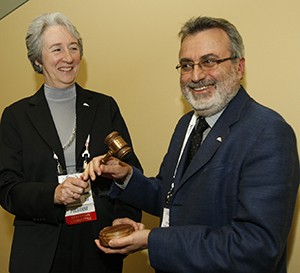
Roberto Civitelli, MD, the Sydney M. and Stella H. Schoenberg Professor of Medicine, has been elected president of the American Society for Bone and Mineral Research (ASBMR), the world’s leading scientific organization for bone health research.
Utility work for the Campus Renewal Project on the Medical Campus will require the temporary closure of Parkview Place Friday, Nov. 1, starting at 11 a.m. The work is expected to continue for eight to 10 hours.
Lorraine A. Goffe-Rush, assistant vice chancellor for human resources at Washington University in St. Louis, has been named vice chancellor for human resources, according to Chancellor Mark S. Wrighton. Goffe-Rush will succeed Ann B. Prenatt, vice chancellor for human resources since 2003, when she retires Dec. 31.
Washington University in St. Louis and Fudan University’s joint Executive MBA program in Shanghai moved up three spots to No. 6 in the Financial Times annual ranking of the world’s best EMBA programs.
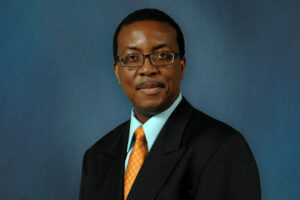
Anthony Odibo, MD, specializes in identifying and treating high-risk pregnancies using ultrasound and genetic testing. In his research, he evaluates the effectiveness of fetal surgeries and diagnostic techniques before birth.
The School of Medicine’s Evan D. Kharasch, MD, PhD (left) and J. Evan Sadler, MD, PhD, have been elected to the Institute of Medicine of the National
Academy of Sciences, one of the highest honors medical scientists in the United States can receive.
The 17th birthday celebration of the Elizabeth Danforth Butterfly Garden, held Oct. 6, drew 60 guests to enjoy the garden and honor longtime volunteer leader Jean Davis. The garden was dedicated in 1996 in honor of Elizabeth Gray Danforth, the late wife of Washington University Chancellor Emeritus William Danforth.
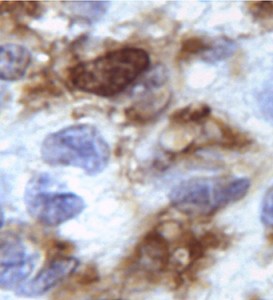
Scientists at the School of Medicine have identified a biological marker that may help predict overall survival of people with deadly brain tumors. The marker is made by noncancerous cells known as monocytes (pictured in brown).
At 8 p.m. Thursday, Oct. 24, Leach will read from her work as part of The Writing Program’s fall Reading Series. The talk, which is free and open to the public, will take place in Hurst Lounge, Room 201, Duncker Hall. A reception and book signing will immediately follow.