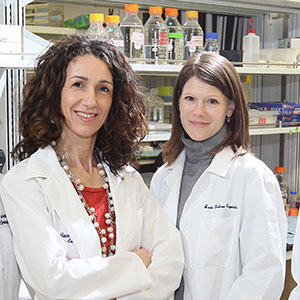
Health-care disparities will be among the topics discussed at the Midwest region’s Student National Medical Association (SNMA) annual conference this weekend on the Washington University Medical Campus. School of Medicine students Lawrence Benjamin and Lauren Martin, the university’s SNMA co-presidents, were leaders in organizing the conference for medical and premedical students.
School of Medicine researchers studying how cancer spreads into bone have made a surprising discovery that suggests several investigational anti-cancer therapies just entering the drug-development pipeline may not have the desired effect. The study indicates that the drugs inadvertently may promote cancer.
Veteran Ian Smith barely graduated from high school. Today, he is earning his degree in global leadership and management in University College in Arts & Sciences and is leading a team of engineers to develop low-cost prosthetics using 3D printers.
Nominations are now open for the Gephardt Institute for Public Service’s Civic Scholars Program. The program now consists of both a classic and a study abroad cohort. Faculty, staff and administrators can nominate sophomores for either group here. The nomination deadline is Dec. 2.
Religion & Politics, the online news journal of the John C. Danforth Center on Religion & Politics at Washington University in St. Louis, won the Gerald A. Renner Enterprise Religion Report of the Year Award at the Religion Newswriters Association’s annual awards ceremony in Austin, Texas.
This holiday season, the Washington University in St. Louis community can bring burned-out or unwanted light strings to campus to be recycled. WUSTL’s Office of Sustainability and the Sustainability Action Team at the School of Medicine are partnering with StLouisGreen.com and Operation Food Search on the initiative, which runs Nov. 16-Jan. 12.
Is privacy a “right”? What are we willing to sacrifice for privacy? How consistent are our beliefs about privacy and how consistently do we “practice” it? In response to these types of questions, Washington University in St. Louis experts on privacy issues, ranging from the history of privacy to privacy law, will participate in a roundtable discussion, titled “Privacy and Surveillance,” from noon to 2 p.m. Wednesday, Nov. 20, in Anheuser-Busch Hall, Bryan Cave Moot Courtroom.
Some 10 boxes, weighing over 100 pounds and
carrying everything from breakfast bars, coffee, air fresheners, hand
sanitizers, trail mix and home-baked goods, are on
their way to U.S. troops in Afghanistan, thanks to Washington
University’s Military Care Package group. With the November mailing, the group reached another milestone. Since 2004, WUSTL staff, students, faculty and
administrators have donated, packaged and shipped more than eight tons of supplies to troops serving in Iraq and
Afghanistan.
Daniel E. Feder, JD, has been named managing director of private markets at Washington University Investment Management Co. (WUIMC) — the investment office for the endowment at Washington University in St. Louis. As a senior member of the WUIMC, Feder will play a key role in the overall management of WUSTL’s endowment and other university assets, which were valued at $6.2 billion at the end of the 2013 fiscal year. His appointment is effective Dec. 2.