Provost Holden Thorp, PhD, discusses the important role of the humanities in American higher education in delivering the Phi Beta Kappa/Sigma Xi Lecture for the Assembly Series earlier this month. Held annually, the lecture is part of the Phi Beta Kappa initiation ceremony. This year, 81 students were inducted into the prestigious honor society.
Several offices in facilities management at the School of Medicine are consolidating services and business operations beginning May 5. They will be located on the first floor of Olin Residence Hall. Custodial services, facilities engineering and parking and transportation will merge in the newly named Facilities Integrated Service Center (FISC).
The School of Medicine is home to an internationally renowned center for multidisciplinary research of neurofibromatosis and comprehensive care of patients affected by it. The university’s Neurofibromatosis Center will host a symposium May 16 that will bring together patients, their family members and researchers to discuss the latest insight into the diagnosis and treatment of NF.
WUSTL media specialist and LouFest founder Brian Cohen recommends tonight’s Lost in the Trees concert. The band’s newest album bursts with energy and catchy songwriting.
PB&Joy, WUSTL’s annual food drive, collected a record 16,908 pounds of nutritious, kid-friendly food for Operation Food Search this month. That’s more than double the amount collected last year.
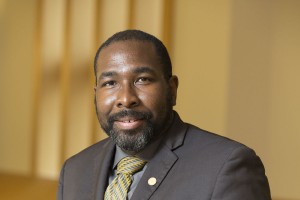
Dedric Carter, PhD, has been appointed to the newly created position of associate provost and associate vice chancellor for innovation and entrepreneurship at Washington University in St. Louis. He has been associate dean for international education and research and professor of the practice in the School of Engineering & Applied Science. The appointment is effective June 1, according to Holden Thorp, PhD, university provost and executive vice chancellor for academic affairs; and Henry S. Webber, executive vice chancellor for administration.
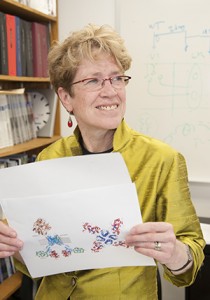
Large regions of the genome that were once referred to as “junk” DNA have been linked to human heart failure, according to research led by Jeanne Nerbonne, PhD, of Washington University School of Medicine in St. Louis.
The Community Service Office will hold a brown-bag session at noon Monday, April 28, in Danforth University Center, Room 233, to discuss ways to expand the K-12 Connections program.
Participants in the Faculty Reach Out Program (FROP), held earlier this month at the School of Medicine, attended a two-day workshop that included meetings with faculty to discuss clinical and research interests, tours of research facilities and networking opportunities with other FROP participants. FROP was initiated to create a pathway to recruit women and underrepresented minorities for faculty appointments.
Retired Lt. Gen. George J. Flynn, who served as deputy commandant for combat development and integration for the U.S. Marine Corps, makes a point during his remarks at a formal Dining-Out event April 17 in the Knight Center. Sponsored by the Olin Veterans Assocation, the Dining-Out event is a formal military tradition for members of a company or other unit aimed at fostering camaraderie.