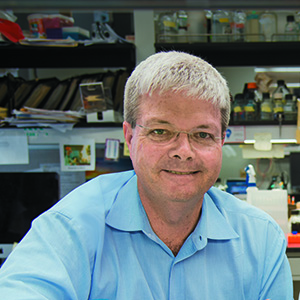
Guy Genin, PhD, has been named a 2014 Global Scholars Fellow at Tsinghua University in Beijing. Genin, a professor of mechanical engineering in the School of Engineering & Applied Science, will be part of a team studying how engineers can help older adults make decisions about orthopedic surgeries involving rotator cuff repair.
Washington University researchers are studying African Americans with diabetes to learn whether vitamin D can slow the development of cardiovascular problems. Shown is principal investigator Carlos Bernal-Mizrachi, MD, with study patient Helen Randall.
The fourth annual Lavender Recognition Ceremony will take place at 3 p.m. Wednesday, May 14, in College Hall on the South 40. The ceremony honors the achievements and contributions of graduating lesbian, gay, bisexual, transgender and queer students and their allies.
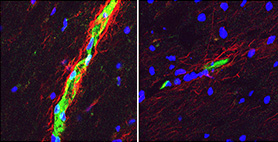
A newly identified difference between female and male brains with multiple sclerosis (MS) may help explain why so many more women than men get the disease, researchers at Washington University School of Medicine in St. Louis report.
A multi-institutional campaign to harness a newly recognized cellular defense against infection is being led by researchers at the School of Medicine. A $32 million grant from the National Institutes of Health is funding the collaborative, which could lead to drugs with unprecedented versatility in fighting different infections. Washington University’s Herbert W. Virgin IV, MD, PhD, is the principal investigator.
New research suggests that certain types of brain cells may be “picky eaters,” seeming to prefer one specific energy source
over others. The finding has implications for understanding the cognitive decline seen in aging and degenerative diseases such as Alzheimer’s and multiple sclerosis.
From Daedalus to da Vinci, from Kitty Hawk to Cape Canaveral, the dream of flight has powered some of the world’s most ambitious feats of design and engineering. On April 28, freshman architecture students from the Sam Fox School launched their own aeronautical experiments from the top of Art Hill in Forest Park.
A group of a two dozen corporate leaders, including
Warren Buffet, is trying to influence American companies to increase the
number of women in positions of senior leadership. The effort, called the 30% Club,
is an expansion of an effort in Great Britain to increase female corporate
board representation there to 30 percent by the end of 2015. But can it work in the United States? Maybe, with more defined objectives, says Olin Business School’s Michelle Duguid, PhD, an expert on women in the workplace.
An undergraduate success story: Jolijt Tamanaha spent her last weeks of junior year at Washington University in St. Louis making a deal to sell a startup she co-founded called Farmplicity — an online marketplace that matches restaurants with local farmers — founded in a course through Olin Business School called The Hatchery.