Young adults with autistic tendencies don’t often engage in social or binge drinking, but if they drink, they are slightly more likely than their peers to develop alcohol problems, according to new research from Duneesha De Alwis (right) and Arpana Agrawal at the School of Medicine.
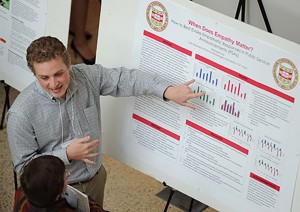
More than 170 Washington University in St. Louis undergraduates showcased their research projects through poster, visual and oral presentations during the 2014 Spring Undergraduate Research Symposium, held April 28 in Bauer and Knight halls.
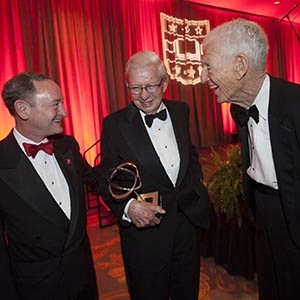
Former School of Engineering & Applied Science Dean James McKelvey received the Search Award for outstanding citizen of Washington University at the annual Eliot Society dinner held this year on April 23 at the Ritz Carlton Hotel. In addition to the award presentation, Eliot Society members were treated to a talk by author James Bradley.
Jeffrey I. Gordon, MD, director of the Center for Genome Sciences and Systems Biology, has won the 2014 Passano Foundation Award for his pioneering studies showing how the trillions of microbes that live in the gut influence human health.
On Sunday, May 4, dozens of models will take the stage wearing scores of outfits by 26 aspiring designer from the Sam Fox School of Design & Visual Arts. Here are some highlights from the senior class.
Many privacy discussions follow a similar pattern, and involve the same kinds of arguments. It’s commonplace to hear that privacy is dead, people — especially kids — don’t care about privacy, people with nothing to hide have nothing to fear, and privacy is bad for business. “These claims are common, but they’re myths,” says Neil M. Richards, JD, privacy law expert and professor of law at Washington University in St. Louis.
Ralph J. Damiano Jr., MD, an internationally known cardiac surgeon, has been named chief of the Division of Cardiothoracic Surgery at Washington University School of Medicine.
David Balota, PhD, a leader in the study of cognitive breakdowns that occur in Alzheimer’s, and Steven L. Teitelbaum, MD, a world-renowned bone biologist, will receive Washington University in St. Louis’ 2014 faculty achievement awards, Chancellor Mark S. Wrighton announced.
Arts & Sciences recognized a beloved faculty member, a Pulitzer Prize winner, a driving force in continuing education, a devoted advocate, and entrepreneurs in energy and public relations during its 16th Annual Arts & Sciences Distinguished Alumni Awards ceremony, held April 24 at the Hilton Frontenac Hotel.
Senior drama major Sarah Palay recommends Mainstreet Musicals – St. Louis Festival, a showcase for new works created by St. Louis writers, producers and actors. It takes place this weekend in Forest Park.