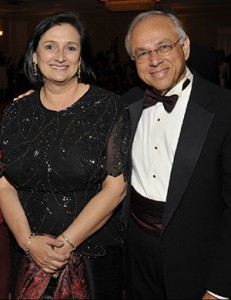
Two Washington University in St. Louis faculty members with strong global ties will assume additional responsibilities as assistant vice chancellors for international affairs, announced Chancellor Mark S. Wrighton. Shenyang Guo, PhD, will serve as assistant vice chancellor for international affairs-Greater China (Mainland China, Hong Kong, Macau and Taiwan), and Gautam N. Yadama, PhD, as assistant vice chancellor for international affairs-India.
Drawing on ballet and contemporary dance, Arabesque captures the ancient, agrarian rhythms of life in rural Vietnam. On Oct. 24 and 25, the celebrated company, which is based in Ho Chi Minh City, will make its U.S. premiere as part of the Edison Ovations Series.
At its fall meeting Friday, Oct. 3, the Washington University in St. Louis Board of Trustees heard special reports on Arts & Sciences and the university’s endowment and received a report from Chancellor Mark S. Wrighton that included updates on administrative appointments, admissions, athletics and construction.
Bo-Ruei Chen, PhD, postdoctoral research scholar in the (Barry) Sleckman Lab, has received a three-year, $167,346 fellowship from the National Institutes of Health (NIH) for research titled “Pathways that Preserve Genome Stability during Antigen Receptor Gene Assembly.” …
Tired and hungry and far from home, cast adrift by angry powers, the hero escapes monsters, navigates hostile lands and struggles to reunite with beloved family. In “Anonymous,” Naomi Iizuka pays sly homage to “The Odyssey” of Homer, reimagining a foundational work of Western literature through the lens of contemporary immigration.
Several “blockbuster” cases — including freedom of speech, religious freedoms in prison, pregnancy discrimination and a possible decision on gay marriage — are on the docket for the Supreme Court, which begins its new session this month. But don’t expect any decisions until next June. New research led by the School of Law finds big cases are disproportionately decided just before the court’s summer recess.
Presented by the Skandalaris Center for Entrepreneurial Studies, the Suren G. Dutia and Jas K. Grewal Global Impact Award was established last year in the belief that the power of technology can solve real world problems by giving highly motivated entrepreneurs the tools to foster innovation. The first recipient will be selected from a field of six outstanding finalists at an Oct. 6 reception.
Douglas Chalker, PhD, associate professor of biology in Arts & Sciences, has been awarded $170,000 from the National Science Foundation to continue work on his project, “DNA Elimination Mechanisms in Tetrahymena.”
Young Scientist Program volunteers Claire Weichselbaum and Brian Lananna, graduate students in the Division of Biology & Biomedical Sciences, were among several YSP volunteers who participated in Family Med School at the St. Louis Science Center. The two demonstrated how lungs function.
Friends and fans of celebrated author William H. Gass, PhD, the David L. May Distinguished Professor Emeritus in the Humanities in Arts & Sciences at Washington University in St. Louis,
gathered Sept. 28 in Umrath Lounge to mark his 90th birthday with a special reading from his collected works. The reading, “Passages of Time,” was sponsored by University Libraries.