In 2014, Washington University continued to play a major role in the St. Louis community while students and alumni made their mark on campus. Among the stories were the debut of the $80 million Lofts of Washington University, a continued investment in Cortex, the innovation district, and two unforgettable alumni.
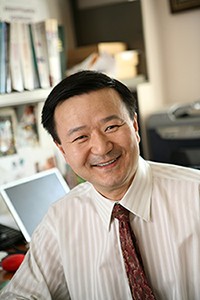
Rebecca Copeland, PhD, is one of two winners of the 2014-15 Japan-U.S. Friendship Commission Prize for the Translation of Japanese Literature for her translation of Kirino Natsuo’s “The Goddess Chronicle.” She is chair of the East Asian Languages and Cultures Department in Arts & Sciences at Washington University in St. Louis.
Washington University researchers worked in the local community and across the globe in 2014 to better understand our bodies, our minds and our cultures.
This year, Washington University researchers advanced our understanding of schizophrenia and Alzheimer’s disease, and developed devices to help surgeons see cancer cell and scientists to capture new vistas through the world’s fastest 2-D camera.
The School of Medicine’s 11th Annual Art Show is accepting submissions from students, faculty and staff. The art show will be held in the Farrell Learning and Teaching Center atrium, 520 S. Euclid Ave., from Jan. 13 through Feb. 11.
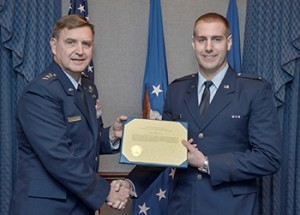
Alexander Cox, a recent graduate of the School of Engineering & Applied Science at Washington University in St. Louis, was named the 2014 Air Force Cadet of the Year at a Dec. 5 ceremony at the Pentagon in Washington, D.C. He is the 15th recipient of the award.
A team of biomedical engineers in the School of Engineering & Applied Science at Washington University in St. Louis has made an important discovery about how a channel in the heart responds to membrane voltage, which causes the channel to open and also determines the properties of electrical signals that control the heart, contrary to what had previously been believed.
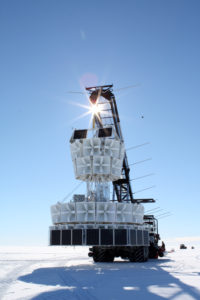
Calm winds allowed the ANITA III experiment to be launched into the polar vortex above Antarctica on Dec. 17. The instrument consists of 48 radio receivers that are listening for pings that will be generated when ultra-high-energy cosmic rays generate radio-frequency bursts that reflect off the ice and up to the instrument at a float altitude of 120,000 feet, four times higher than commerical airliners cruise.
The Lofts of Washington University, an $80 million residential and retail project, has been awarded LEED Platinum certification by the U.S. Green Building Council. Located in the Delmar Loop, the project debuted in August 2014 and features 167 fully furnished apartments for Washington University undergraduate students; United Provisions, a full-service grocery store and restaurant; and the 24-hour Peacock Loop Diner.