Ten Washington University in St. Louis students were among the nearly 500 Stamps Scholars from 41 universities across the nation who attended the Stamps Family Charitable Foundation’s third national convention.
Caitlyn Jenner’s first public appearance on the cover of Vanity Fair has sparked quite a stir. The Twitter account for Jenner, formerly Bruce Jenner, reached 1 million followers in just over four hours. Her story reminds us that even the most personal decisions are linked to broader social conditions, says an expert on later-in-life gender transitions at Washington University in St. Louis.
Construction to upgrade a Metropolitan Sewer District (MSD) storm-sewer line on Duncan Avenue west of Newstead Avenue has been delayed. The project led to the closure of the north entrance to the St. Louis Children’s Hospital (SLCH) staff garage. A completion date has not been determined.
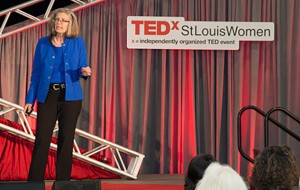
Victoria J. Fraser, MD, head of the Department of Medicine, was a featured speaker at TEDxStLouisWomen, Thursday, May 28. The presentations were part of TEDWomen, a national conference focused on women and girls as creators and change-makers. Fraser spoke about antibiotic resistance and its evolution into a public health crisis.
p.MsoNormal, li.MsoNormal, div.MsoNormal
{margin:0in;margin-bottom:.0001pt;font-size:12.0pt;font-family:”Times New Roman”;}
.MsoChpDefault
{font-size:10.0pt;}
@page WordSection1
{size:8.5in 11.0in;margin:1.0in 1.25in 1.0in 1.25in;}
div.WordSection1
{page:WordSection1;}
Four students at Washington University in St. Louis
successfully completed the Certificate in Renewable Energy and the Environment
this year
and were recognized at an event at the Whittemore House.
Several key provisions of the Patriot Act ended this week, after the Senate let them expire. As a result, the National Security Agency has, at least temporarily, halted the bulk data collection program used to amass phone data for millions of Americans. Neil Richards, JD, professor of law at Washington University in St. Louis and one of the country’s foremost academic experts on privacy law, said the fact that expiration of these powers hasn’t provoked mass outrage shows Americans deeply value privacy.
Rohit Pappu, PhD, the Edwin H. Murty Professor of Engineering at Washington University in St. Louis, has learned from his students as well as his mentors. He can name every researcher he has worked with throughout his career. Pappu studies intrinsically disordered proteins and their role in neurodegenerative disorders such as Huntington’s, Alzheimer’s and Parkinson’s diseases.
From the Campaign Chair As of June 30, 2015, Leading Together: The Campaign for Washington University had secured $1.95 billion in gifts and commitments toward a minimum goal of $2.2 billion by June 30, 2018. Leading Together earlier surpassed the total of $1.55 billion raised during the entire previous campaign. We are very grateful to […]
Washington University staff and faculty have one more month to join the 5,000 employees who already have contributed to Our Washington, the faculty and staff component of Leading Together: The Campaign for Washington University. Donations support scholarships, strengthen academic and scientific initiatives, advance learning and enhance facilities.
In response to a growing number of alumni and expanding
research and education partnerships in China, Washington University in
St. Louis is opening an office in Shanghai’s Knowledge Innovation
Community. “The Shanghai office will serve as a key resource for
our alumni, prospective students and friends,” Chancellor Mark S.
Wrighton said.