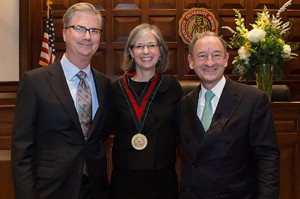
Nancy Staudt, JD, PhD, dean of the School of Law at Washington University in St. Louis, has been installed as the inaugural Howard and Caroline Cayne Professor of Law. A lecture and reception to celebrate the occasion were held Oct. 22 in the Bryan Cave Moot Courtroom in Anheuser-Busch Hall.
Jay F. Piccirillo, MD, of Washington University School of Medicine in St. Louis, has been named editor-in-chief of JAMA Otolaryngology-Head & Neck Surgery, one of 10 specialty journals in The Journal of the American Medical Association’s (JAMA) network of publications.
Stuart Weiss, MD, a beloved, longtime professor of clinical neurology at Washington University School of Medicine, died Oct. 27, 2015, in St. Louis. He was 85.
The United States Supreme Court agreed Nov. 6, for
the fourth time in three years, to rule on challenges to the Affordable
Care Act. This time the court will rule on the birth control mandate. A decision siding with large nonprofit corporations in
this new case means that employers would prevail at significant cost to
employees, said Elizabeth Sepper, JD, religious freedom and health law expert at Washington University in St. Louis.
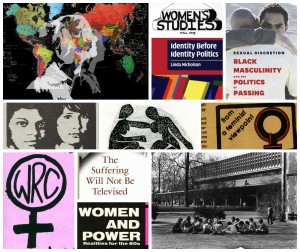
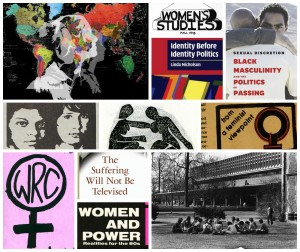
In 1972, Washington University launched one of the nation’s first academic programs in women’s studies. This fall, Arts & Sciences celebrates a new milestone as Women, Gender, and Sexuality Studies becomes a full department.
In 1972, Arts & Sciences at Washington University in St. Louis launched one of the nation’s first academic programs in women’s studies. Over the years, the program has continued to grow and expand, establishing itself as an important resource for students and faculty working on gender-related topics. On Nov. 5, the university will celebrate a […]
Salmon and other freshwater fish and amphibians supercharge their ability to see red and infrared light. Scientists at the School of Medicine have shown that this evolutionary adaptation hinges on the activity of an enzyme that converts vitamin A1 to vitamin A2, enabling the aquatic creatures to more easily navigate murky waters.
More than half of black youth report that they or
someone they know was harassed by or experienced violence from the
police, compared with one third of white youth and one quarter of Latino
youth, according to a new report on black millennials co-authored by
researchers at Washington University in St. Louis and the University of
Chicago.
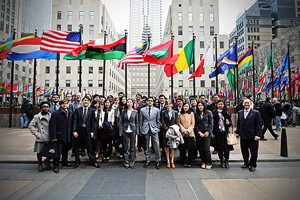
On its 10-year anniversary, the McDonnell International Scholars Academy, Washington University in St. Louis’ lead international initiative, has much to celebrate: a strong network of 29 partner research universities around the world, 67 scholars in residence, 72 academy alumni and countless collaborations and connections. To mark the milestone, the McDonnell Academy is hosting an alumni workshop Friday through Sunday, Nov. 6-8, on the Danforth Campus.