Americans were shocked by the Jan. 3 raid on Venezuela and by the arrest of President Nicolas Maduro and his wife Cilia Flores. But the incident represents the return of something very old to U.S. foreign policy.
The Monroe Doctrine was invented in 1823 by John Quincy Adams, Secretary of State to President James Monroe. The doctrine declared the Western Hemisphere off-limits to great powers such as Great Britain, France and Spain, which might attempt to resume control of former colonial holdings. Since the United States lacked a powerful navy to enforce the doctrine, European compliance was frankly amazing, though it took until the end of the 19th century to reach full effect.

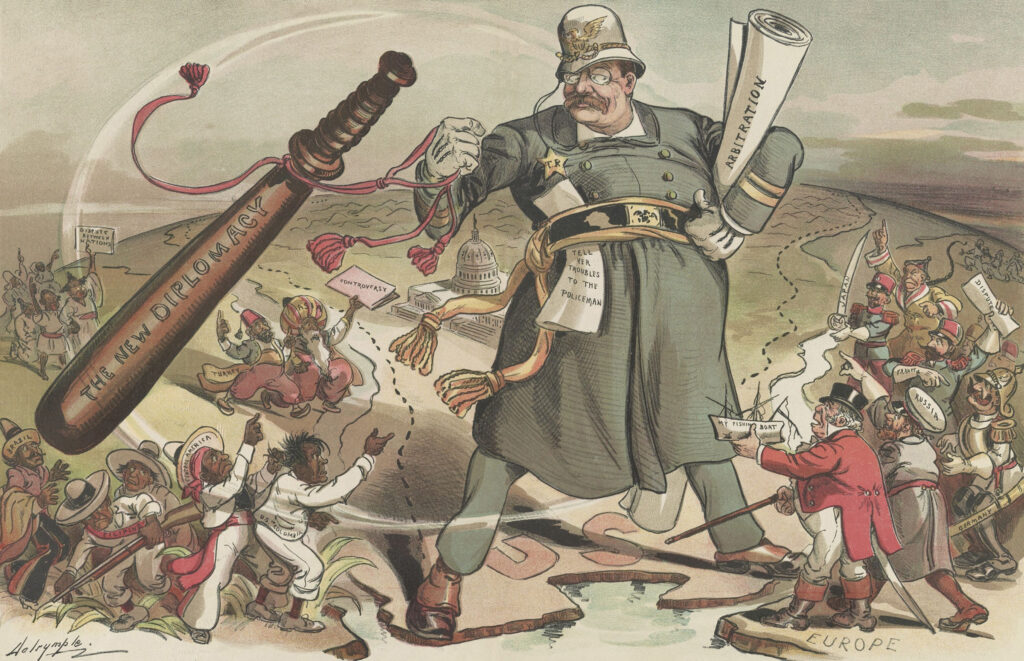
Along the way, several presidents invoked the doctrine. During the Mexican-American War (1836-38), James Polk used it to justify absorbing northern Mexico into what is now the American Southwest. Theodore Roosevelt’s famous “corollary” gave the U.S. military broad power to meddle in Cuba, Puerto Rico, the Dominican Republic, Panama and Venezuela. In both cases, the doctrine simply rationalized aggressive U.S. military action. It did not keep out foreign powers — thereby bowdlerizing Monroe’s intention. On the eve of the First World War, Woodrow Wilson proclaimed the doctrine dead.
Astoundingly, the Trump Administration has resurrected it. Since inauguration day, eyeball-rolling rhetoric about Latin American regime change has recalled Roosevelt’s bluster about San Juan Hill. But in December, U.S. National Security Strategy formalized such statements into official policy. Members of the national security establishment are taking victory laps over Operation Absolute Resolve, and some exiled Venezuelans have celebrated in the streets — there are elements indeed at which to marvel — but many at home and around the world are questioning its wisdom, validity and legality. Even some in the MAGA movement are wondering how invading a foreign country is good for them.
One thing is certain. Saber rattling over Mexico, Cuba, Columbia, Nicaragua, Panama—and, yes, even Greenland—can’t be dismissed. If it was not clear before, it should be now: The Trump administration really is conducting national security in the Western Hemisphere according to the Monroe Doctrine, or what is coming to be called the “Donroe Doctrine.”
What does the Donroe Doctrine want? Broadly speaking, it wants to curtail the flow of drugs and immigrants into the U.S. It wants to deport refugees. It opposes the Communist government in Cuba and the left-leaning one in Nicaragua. It wants Panama to cancel contracts with China. Indeed, it wants Latin American countries to abandon business relations and curtail diplomatic relations with U.S. adversaries such as China, Russia and Iran.
Which brings us to oil. Trump’s pursuit of oil is no secret. He believes Venezuela still owes Western energy giants for nationalizing the industry in the 1970s. This, he’s claimed, is all the justification needed for removing Maduro. In the next 18 months, he says, American companies will return to Venezuela, improve infrastructure and resume oil output and profits.
Also in play are geopolitical and energy security dynamics. China imports 370 thousand barrels from Venezuela per day. That’s a lot of leverage. Similarly, resuming control of the Panama Canal would hamper Chinese supply chains. For the administration, economic security is national security.
But the pitfalls are many. The administration has condemned forever wars in Iraq and Afghanistan. Can Venezuela really be “run” from afar? Venezuela has a large, capable military and heavily armed militias. “Boots on the ground” will quickly get messy.
For critics, Trump’s gunboat diplomacy raises as many questions as it answers. For instance: After creating a very successful international order in the wake of World War Two, why is the United States returning to a blatant form of economic imperialism? Doesn’t the lack of congressional approval indicate a violation of U.S. law? Or does the “Don” in “Donroe Doctrine” simply stand for a mafia don running his own criminal syndicate? Won’t Trump’s actions further strain the credibility of U.S. laws, institutions and elected officials?
There is something valid to each critique, but they miss an essential point. The Trump administration’s behavior in Latin America is neither new nor unusual. It is part of a long tradition (though hardly venerable) in U.S. foreign policy. Even before our founding, George Washington and Ben Franklin held investments in land west of Appalachia — in defiance of the British government, which sought to avoid more Indian wars. Thomas Jefferson purchased the Louisiana territory from a desperate Napolean for a mere $15 million. After the Civil War, presidents Johnson, Grant, McKinnley, Roosevelt and Taft aggressively pursued expansionist policies.
Such policies have gone by many names—Manifest Destiny, Monroe Doctrine, dollar diplomacy, Open Door. Nationalists may celebrate them. Realists may try to deploy them strategically. And liberals may condemn them as disastrous, self-defeating imperialism. But they are part of our national DNA.
Krister Knapp is teaching professor and coordinator of Crisis & Conflict in Historical Perspective (CCHP) at Washington University in St. Louis, where he teaches courses in U.S. National Security and Foreign Policy.
Knapp will present a free lecture as about Trump and Venezuela at 5:30 p.m. Thursday, Jan. 22, in WashU’s Hurst Lounge. The talk is part of the spring CCHP Speaker Series. For more information, click here.