
Daylight savings offers no savings, poses health risks, expert says
People often feel draggy the day after they have to set
their clocks forward in the spring but often shrug off that feeling as
trivial. In fact, says Erik Herzog, PhD, a neuroscientist at Washington
University in St. Louis, who studies biological clocks, jamming our
biological clocks into reverse, as daylight savings time does, has
serious consequences.
New cyclotron to help doctors detect cancers
A new cyclotron recently was installed at the East Building on the School of Medicine campus. The unit, in the works for more than a decade, is a particle accelerator that will produce radioactive compounds, many of which are used with positron emission tomography (PET) scanners to detect specific types of cancers.
Free birth control doesn’t promote risky sexual behavior in women
Researchers at the School of Medicine have shown that providing women with free contraception does not increase the likelihood that they will have sex with multiple partners, as critics of the practice have suggested. Shown is the study’s first author, Gina Secura, PhD.
Civil rights champion Chai Feldblum to commemorate Title VII and the Civil Rights Act of 1964
Civil rights champion and Equal Employment Opportunity Commission member Chai Feldblum, JD, will visit Washington University in St. Louis on March 17 and 18 to participate in programs commemorating the passing of Title VII, a key piece of the Civil Rights Act of 1964, as well as to celebrate International Women’s Day.
Motionhouse Dance Theatre March 21 and 22
Water. It is the source of life, the indispensible molecule, the elemental force that carves rivers, topples mountains, nurtures crops and extinguishes flame. In “Scattered,” Motionhouse Dance Theatre combines daring movement, mid-air acrobatics and state-of-the-art projection technology to capture the might, majesty and savagery of water.
Maine becomes first state to provide college savings for all newborns
On March 6, the state of Maine became the first in the United States to make college savings for newborns universal and automatic, putting into practice research pioneered by Michael Sherraden, PhD, the George Warren Brown Distinguished University Professor and director ofthe Brown School’s Center for Social Development at Washington University in St. Louis.
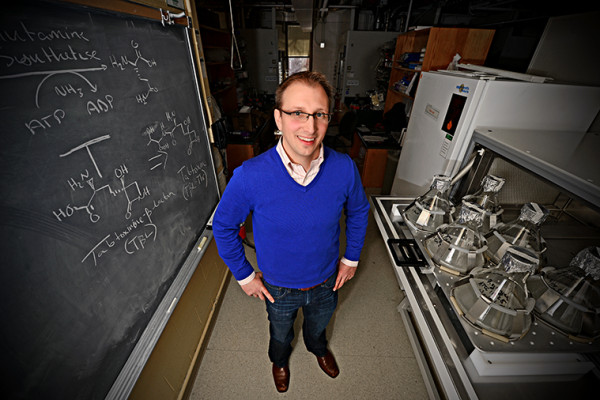
New drugs for bad bugs
Washington University in St Louis chemist Timothy Wencewicz says we’ll stay ahead of antibiotic resistance only if we find drugs with new scaffolds, or core chemical structures. One promising candidate, an antibiotic made by a bacterium than infects plants, caught his attention because it contains an “enchanted ring,” the beta-lactam ring that is found in penicillin. In this drug candidate, however, it acts against a different target than the penicillins.
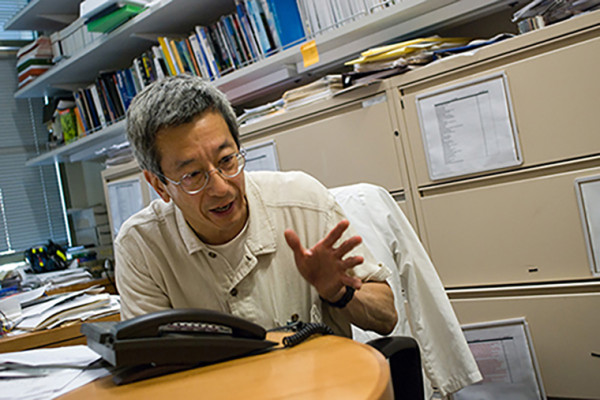
2014 Leopold Marcus lecture by Nobel laureate
Roger Tsien, one of three chemists who won the Nobel Prize in Chemistry
in 2008 for the discovery and development of green fluorescent protein, will give the Leopold Marcus lecture at Washington University in
St. Louis. His talk, “Fluorescent Molecules for Fun and Profit,” is intended for a general audience and will take place at 4 p.m. Wednesday, March 12, in the Laboratory Sciences Building, Room 300. The talk is free and open to the public.
Biomarkers of cell death in Alzheimer’s reverse course after symptom onset
Three promising biomarkers being studied to detect Alzheimer’s disease in its early stages appear to undergo a surprising shift as patients develop symptoms of dementia, researchers led by Anne Fagan, PhD, at the School of Medicine report.
Drake honored with coordinator excellence award
Tia Drake, executive director of Graduate Medical Education (GME) at the School of Medicine, has been honored with the GME Institutional Coordinator Excellence Award.
View More Stories