
Faculty learn from each other at i teach symposium
Washington University in St. Louis faculty participated in the annual i teach symposium at the Knight Center earlier this month. It was a chance for faculty and staff from all seven schools to exchange ideas about innovative teaching across disciplines.
Announcing Washington University’s Spring 2014 Assembly Series
The Washington University in St. Louis Assembly Series turned 60 in 2013, and to mark such an august occasion, it’s fitting to remember why the lecture series was conceived in the first place. The Assembly Series launched during the institution’s centennial celebration in 1953 as a way to involve the broader St. Louis community in the robust intellectual life on campus.
Robyn Hadley named associate vice chancellor, director of Ervin Scholars Program
Robyn S. Hadley, founder and executive director of the “What’s After High School” program in Burlington, N.C., has been named associate vice chancellor and director of the prestigious John B. Ervin Scholars Program at Washington University in St. Louis.
Child savings accounts promote positive social-emotional development, study finds
A college savings account in a child’s name not only gives parents hope for the future, it also results in improved social-emotional health for their children. That’s the result of a new study released Jan. 27 online in JAMA Pediatrics. The study, led by Washington University in St. Louis’ Center for Social Development in collaboration with the state of Oklahoma, began in 2007 as SEED for Oklahoma Kids, an innovative policy experiment to invest in children at birth. The program automatically opened and deposited $1,000 in an Oklahoma college savings plan account for 1,360 newborns.
Super Bowl ads last months, not just one day
Commercials for the commercials? Arnold Schwarzenegger in tennis gear? A “Full House” reunion? Must be Super Bowl time. “It’s
interesting to see the experience of the Super Bowl ads lasting eight
to 13 weeks on average today compared to one day of viewing the ads
years ago,” says Carol Johanek, adjunct professor of marketing at
Washington University in St. Louis’ Olin Business School.
Strassmann installed as Charles Rebstock Professor of Biology
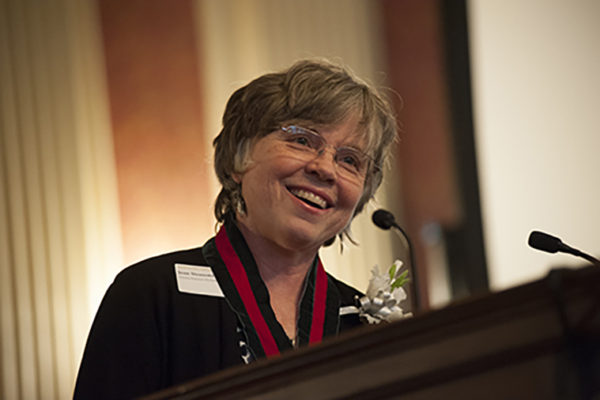
Biologist Joan E. Strassmann, PhD, was installed Jan. 23 as the Charles Rebstock Professor of Biology in Arts & Sciences in a ceremony in Holmes Lounge. Following the formal installation, Strassmann gave an entertaining talk about a high-stakes gamble she and Queller made 15 years ago: to switch from studying cooperation and conflict in social insects, famous for their complex societal arrangements, to studying it in an amoeba, whose claim to fame had been its simple lifestyle.
Students celebrate Lunar New Year with fireworks
Lunar New Year festivities kicked off on campus last weekend with fireworks at Mudd Field. Celebrations continue this weekend, when the annual Lunar New Year Festival offers a student showcase of Asian dance and music.
New target explored for psychiatric drug development
In a surprising discovery, neuroscientists, led by a team from Washington University School of Medicine in St. Louis, have found that a molecule that is a breakdown product of cholesterol in the brain may be a target for developing new drugs to treat schizophrenia and other mental illnesses.
New book provides roadmap for introducing system dynamics into community building
Peter Hovmand, PhD, associate professor of practice at the Brown School and founding director of the Social System Design Lab, has published “Community Based System Dynamics” (Springer 2013) for anyone interested in making communities around the world a better place using system dynamics.
Sixty years of the Assembly Series: spring 2014 schedule released
The WUSTL Assembly Series turned 60 in 2013, and to mark the anniversary, we revisit why the lecture series was conceived in the first place. The Assembly Series launched during the institution’s centennial celebration in 1953 as a way to involve the broader St. Louis community in the robust intellectual life on campus.
View More Stories