
Media Advisory: Take a tour of The Lofts of Washington University
What: Tour The Lofts of Washington University and United Provisions, a new full-service grocery store When: Friday, August 8, 10 a.m.- noon Where: Main lobby of The Lofts, 6255 Delmar Blvd. Who: The following community and project leaders will be available for comment from 10:30-11:30 a.m.:• Art Ackermann, associate vice chancellor for facilities, Washington University• […]
Washington University part of group awarded $20 million for climate variability research
As part of a multi-institutional $20 million effort, researchers at Washington University in St. Louis will conduct several studies, including one that uses medical imaging on plants to see what’s broken or about to break inside (pictured). Four university researchers will receive funding from the National Science Foundation to support work aimed at helping Missouri plants and crops adapt to climate variability.
Sukkah City STL 2014
The sukkah is a small temporary dwelling constructed each autumn for the Jewish festival of Sukkot. This fall, the Sam Fox School of Design & Visual Arts, in partnership with St. Louis Hillel at Washington University, will sponsor “Sukkah City STL 2014: Between Absence and Presence,” a national design competition and exhibition.
McCune to direct Mellon Mays Undergraduate Fellowships
Jeffrey McCune, PhD, has been named director of the Mellon Mays Undergraduate Fellowship Program at Washington University in St. Louis. Funded by the Andrew W. Mellon Foundation in New York, the program aims to increase diversity in higher education by encouraging talented but underrepresented students to pursue doctorates in the humanities and social sciences.
Study reveals one reason brain tumors are more common in men
New research at the School of Medicine helps explain why brain tumors occur more often in males and frequently are more harmful than similar tumors in females. Pictured is the study’s senior author, Joshua Rubin, MD, PhD.
Wash U Expert: High stock prices, low interest rates cause uptick in corporate tax inversions
The United States has the highest corporate income tax rate in the developed world. As
a result, many U.S. companies are turning to tax inversions —
reincorporating overseas by getting acquired by a smaller company in a
country where the corporate tax rate is lower. Adam Rosenzweig, JD, professor of law and expert on international tax, examines why inversions are becoming so popular.
From the provost: Lab safety — going beyond compliance to a positive culture
H. Holden Thorp, PhD, provost of Washington University in St. Louis, led a National Research Council committee that published a report July 31 on lab safety in academic research. He says the most important takeway is that a holistic approach is needed.
Wahl to become head of radiology
Richard L. Wahl, MD, has been named the Elizabeth E. Mallinckrodt Professor and head of radiology at the School of Medicine. He also will serve as director of the
Mallinckrodt Institute of Radiology.
Unintended consequences: More high school math, science linked to more dropouts
Washington University researchers have found that courses intended to better prepare high school graduates for college also drive some students to drop out. They report that policies increasing the number of required math and science courses are linked to a higher dropout rate.
Finding quantum lines of desire
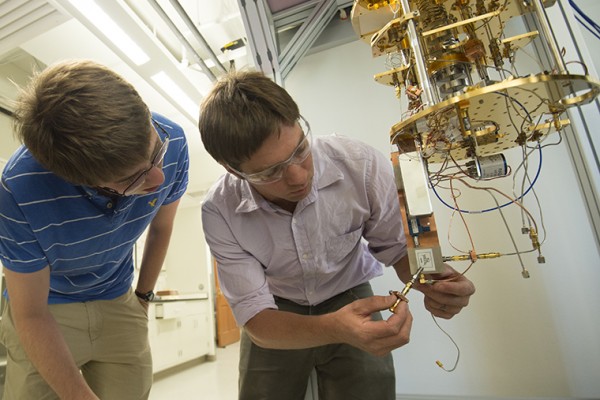
What paths do quantum particles, such as atoms or photons, follow through quantum state space? Kater Murch of Washington University in St. Louis has used a superconducting quantum device to continuously and repeatedly record the paths the device took through quantum state space. From the cobweb of a million paths, a most likely path between two quantum states emerged, much as social trails emerge as people round off corners or cut across lawns between buildings. The research is featured on the cover of the July 31 issue of Nature.
View More Stories