
Mozart’s ‘Requiem’ April 13
A mysterious stranger arrives with a mysterious commission. The fevered composer fears the work may foreshadow his own demise. Mozart’s “Requiem” in D minor is perhaps the most mythologized work by the most mythologized composer in classical music. On April 13, the WUSTL Choirs and Symphony Orchestra will perform the “Requiem” as part of the 2014 Chancellor’s Concert.
Sarah Shun-lien Bynum April 8 and 10
Ms. Beatrice Hempel, teacher of seventh grade, is new—new to teaching, new to the school, newly engaged, and newly bereft of her idiosyncratic father. Grappling awkwardly with her newness, she struggles to figure out what is expected of her in life and at work. So begins Ms. Hempel Chronicles, the acclaimed second novel by Sarah Shun-lien Bynum. On April 8 and 10, Bynum will present a pair of events for The Writing Program in Arts & Sciences.
Photo Opportunity: Relay for Life returns to Washington University’s Francis Field April 5-6
Students will walk historic Francis Field, play games and light luminaria during overnight benefit. Relay for Life kicks off at 6 p.m. Saturday, April 5, on Washington University’s Francis Field.
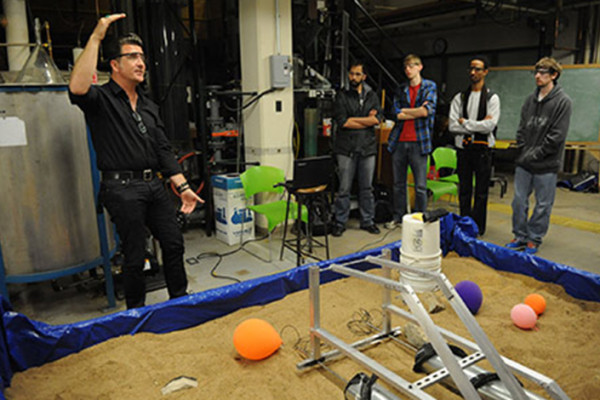
Robots on Mars
Before his Assembly Series talk, Adam Steltzner, a NASA engineer in charge of the Mars Curiosity rover landing, met with WUSTL students and discussed their entry for NASA’s Robotic Mining Competition.
Our Washington: Providing resources
Growing up in the segregated South, Associate University Librarian Virginia Toliver was banned from her local library. But her school library opened her up to a world beyond Mississippi. She donates to WUSTL to build a stronger Olin Library.
PB&Joy food drive kicks off today; supports Operation Food Search
The goal of the campus PB&Joy food drive is to help feed 135,000 hungry children. Campus Kitchen, which boasts 275 WUSTL student volunteers and serves 2,250 meals annually, is one of many organizations that depends on Operation Food Search.
Cutting phosphate in diet reduces deaths, heart problems related to kidney disease
Severely
restricting dietary phosphate early in the course of chronic kidney
disease can prevent related heart and vascular problems, a new study in rats indicates. Phosphate, an essential mineral, is found in colas, milk, cheese and other dairy products, beans and high-protein foods, and often is added as a preservative in processed foods.
Smoking may dull obese women’s ability to taste fat and sugar
People who smoke also tend to eat more high-fat foods. So do obese people. Now, a team of researchers, including M. Yanina Pepino, PhD, at the School of Medicine, has found that obese women who also smoke have a difficult time perceiving fat and sweetness in their food. And that could lead them to eat even more fatty foods.
Time to celebrate
Olin Business School celebrated its 97th birthday March 28 with barbecue, arcade games and fun in the school’s newly opened Knight and Bauer halls. Pictured is Olin employee Nate Quest.
The $25 philanthropist: Assembly Series features ‘International Bank of Bob’ author on the joys of microloan financing
Bob Harris wanted to help people living in poverty who had an entrepreneurial streak, so he donated $20,000 of his money to individuals he found on the micro loan financing website, Kiva.org. Then he set out to meet them. Then he wrote a book about them. Harris will talk about his philanthropy and his travels for the Skandalaris Cenetr for Entrepreneurial Studies’ YouthBridge lecture on April 10.
View More Stories