
Endecott named managing director of Kansas City EMBA Program
Linda Endecott has been hired as managing director of Washington University in St. Louis’ top-ranked Olin Business School Executive MBA Program in Kansas City. Endecott will lead the university’s efforts to continue the expansion, momentum and reputation of its Executive MBA program, which has been offered in Kansas City since 2010.
Bon Appétit premieres new dishes across campus
If you haven’t eaten on campus lately, you may not know about some tasty new fare. Bon Appétit Executive Chef Pat McElroy says his staff spent the summer creating new, original recipes. Check out the green chile pork tacos or the red pepper-and-spinach frittata.
Medical Campus town halls focus on Ferguson, diversity, inclusion
School of Medicine faculty, staff and students came together for three town hall meetings last week in response to the tragic events in Ferguson. Attendees talked about how to help Ferguson and how to improve diversity and inclusion at the university. Two more meetings will be held on the Medical Campus this week.
Fall 2014 Assembly Series features broad range of voices and perspectives, tackles timely issues
In the wake of civil rights and social justice issues that have emerged following the death of African-American teenager Michael Brown in Ferguson, the fall 2014 Washington University in St. Louis Assembly Series will feature presentations by several eminent civil rights scholars and authors, including NAACP executive Sherrilyn Ifill.
Engineers develop new sensor to detect tiny individual nanoparticles
A team of researchers at Washington University in St. Louis, led by Lan Yang, PhD, the Das Family Career Development Associate Professor in Electrical & Systems Engineering, and their collaborators at Tsinghua University in China have developed a new sensor that can detect and count nanoparticles, at sizes as small as 10 nanometers, one at a time. The researchers say the sensor could potentially detect much smaller particles, viruses and small molecules.
Events bring university community together to reflect, move forward
The first week of the 2014 fall semester at Washington University in St. Louis began in the wake of unrest that followed the Aug. 9 death of African-American teenager Michael Brown in Ferguson, Mo. Events were planned not only for students to lend a voice to the issues, but to encourage all members of the community, both on the Danforth and School of Medicine campuses, to come together in an open and welcoming atmosphere.
Students participate in inaugural global health research program
Washington University’s Global Health Center selected five WUSTL students for its inaugural summer research program, which paired students with faculty mentors to explore issues such as malnutrition, maternal health and access to health care. Pictured is program participant Laura Bliss, a second-year medical student.

Balloon rise over Fort Sumner
In a few days, a balloon-borne telescope sensitive to the polarization of high-energy “hard” X rays will ascend to the edge of the atmosphere above Fort Sumner, N.M., to stare fixedly at black holes and other exotic astronomical objects. It will be carried aloft by a stratospheric balloon that will expand to a sphere large enough to hold a 747 jetliner the float height of 120,000 feet, three times the height at which commercial aircraft fly and on the edge of Earth’s atmosphere. Launching the balloon is not child’s play.
Updated Law Café opens
The updated Law Café in Anheuser-Busch Hall has opened for business. The renovated space, operated by Bon Appétit, is the only dining area on campus to feature Salad By Design and one of only two locations with a carvery. The Law Café also features pizza, soups, grab-and-go items, pastries and Kaldi’s coffee and espresso drinks.
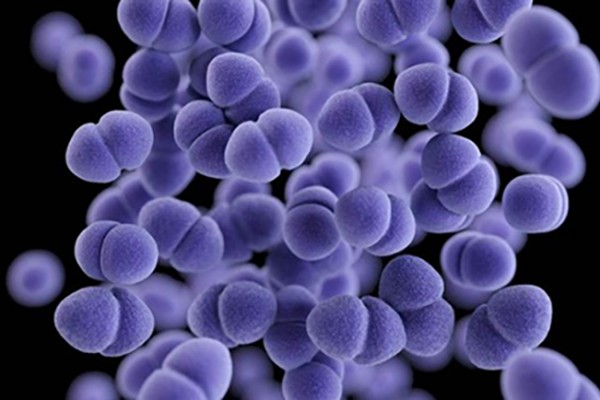
Zombie bacteria are nothing to be afraid of
Scientists at Washington University in St. Louis have obtained the first experimental evidence that there are at least two fail-safe points in the bacterial cell cycle. If the fail-safes are activated, the cell is forced to exit the cell cycle forever. It then enters a zombie-like state and is unable to reproduce
even under the most favorable of conditions. Drugs that trigger the fail-safes are already under development.
View More Stories