
Updated Law Café opens
The updated Law Café in Anheuser-Busch Hall has opened for business. The renovated space, operated by Bon Appétit, is the only dining area on campus to feature Salad By Design and one of only two locations with a carvery. The Law Café also features pizza, soups, grab-and-go items, pastries and Kaldi’s coffee and espresso drinks.
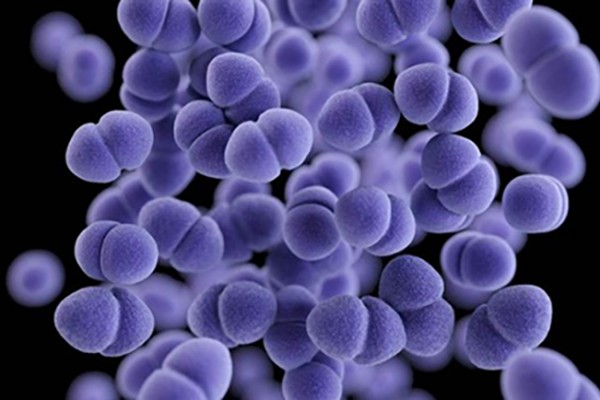
Zombie bacteria are nothing to be afraid of
Scientists at Washington University in St. Louis have obtained the first experimental evidence that there are at least two fail-safe points in the bacterial cell cycle. If the fail-safes are activated, the cell is forced to exit the cell cycle forever. It then enters a zombie-like state and is unable to reproduce
even under the most favorable of conditions. Drugs that trigger the fail-safes are already under development.
Scientists map the ‘editing marks’ on fly, worm, human genomes
In the Aug. 28 issue of the journal Nature, a multi-institution research network called modENCODE (the Model Organism ENCylopedia Of DNA Elements) published three major papers that map and compare the genomes and epigenomes of humans and two model
organisms, the fly, D. melanogaster, and the worm, C. elegans, in unprecedented detail. The fly and worm could serve as model organisms for screening drugs and micronutrients that might alter the epigenome, which is implicated in many diseases.
Social work, public health students get firsthand global health experience in Haiti this summer
This summer, 14 students — seven from the Master of Public Health program, five from the Master of Social Work program and two dual-degree students — joined Lora Iannotti, PhD, on a trip to Haiti. The goal: Give students firsthand experience in issues related to global health, including: health policy, epidemiology, biostatistics and program planning.
Media Advisory: Michael Brown panel discussion
A panel discussion titled “Race, Place, and Violence: A University-Wide Dialogue About Michael Brown” will be held at 7 p.m. Thursday, Aug. 28, in Washington University’s May Auditorium, Simon Hall.
Different forms of Alzheimer’s have similar effects on brain networks
Brain networks break down in a similar fashion in rare, inherited forms of Alzheimer’s disease and much more common uninherited versions of the disorder, reveals a new study led by the School of Medicine’s Beau Ances, MD, PhD.
Nussenbaum named director of head and neck surgical oncology division
Brian Nussenbaum, MD, the Christy J. and Richard S. Hawes III Professor of Otolaryngology, has been named director of the Division of Head and Neck Surgical Oncology in the Department of Otolaryngology at the School of Medicine.
Olin teams up with Human Rights Campaign for LGBT Workplace Inclusion Conference
Olin Business School and the Human Rights Campaign — the largest civil rights organization working to achieve equality for lesbian, gay, bisexual and transgender Americans — hosted an LGBT Workplace Inclusion Conference at Washington University in St. Louis on Aug. 14.

Experiments explain why some liquids are ‘fragile’ and others are ‘strong’
Only recently has it become possible to accurately “see” the structure of a liquid. Using X-rays and a high-tech apparatus that holds liquids without a container, a physicist at Washington University in St. Louis has compared the behavior of glass-forming liquids as they approach the glass transition. The results are the strongest demonstration yet that bulk properties like viscosity are linked to microscopic ones like structure.
New technology may identify tiny strains in body tissues before injuries occur
Washington University researchers have developed algorithms to identify weak spots in tendons, muscles and bones prone to tearing or breaking. The technology, which needs to be refined before it is used in patients, one day may help pinpoint minor strains and tiny injuries in the body’s tissues long before bigger problems occur.
View More Stories