
‘Blues for Mr. Charlie’ runs Feb. 20 to March 1
The killing is not in doubt: A black man is dead; a white man pulled the trigger. The only real question is why. James Baldwin wrote “Blues for Mr. Charlie” in 1964. But today, the echoes of Ferguson are impossible to ignore. The production of the Performing Arts Department in Arts & Sciences at Washington University in St. Louis runs Feb. 20 through March 1 in Edison Theatre.
England named Wolff Professor of Medicine
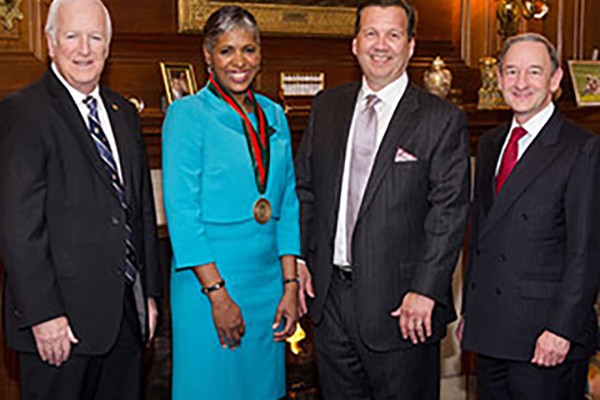
Sarah K. England, PhD, a professor of obstetrics and gynecology, has been named the inaugural Alan A. and Edith L. Wolff Professor of Medicine at the School of Medicine.
Navigating the college application process
Some 120 Washington University students help mentor local high school students through the college application process in a national mentoring program called Strive for College. The program was started on the Washington University campus in 2007 by a group of Rodriguez Scholars and today thrives under the leadership of alum Michael Carter. On Monday, Feb. 16, local high school participants will visit
Washington University, where they will shadow mentors in class
and around campus.
Legail Chandler named vice chancellor for human resources
Legail P. Chandler, assistant dean and executive director of human resources at the School of Medicine, has been named vice chancellor for human resources at Washington University, according to Chancellor Mark S. Wrighton. Chandler, whose appointment is effective immediately, succeeds Lorraine Goffe-Rush, who was named vice president for human resources at the Massachusetts Institute of Technology.
New approach to childhood malnutrition may reduce relapses, deaths
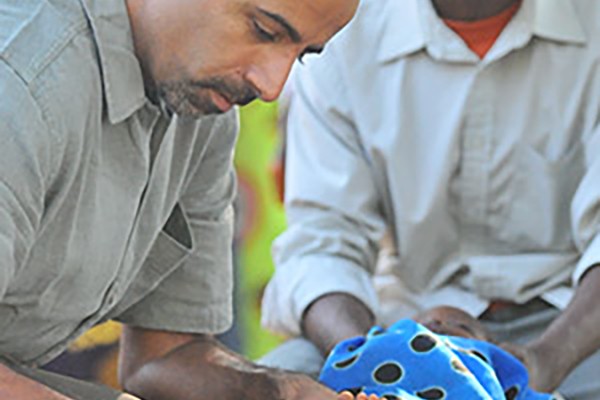
Children treated for moderate acute malnutrition experience a high rate of relapse and even death in the year following treatment and recovery. A new study led by School of Medicine researchers has found that target weights and measures of arm circumference used in assessing the health of malnourished children are insufficient and that raising these thresholds could significantly lower the rate of relapse.
Up next for Assembly Series: religious extremism and the case for reparations
Topics both timely and thought-provoking will be covered in back-to-back Assembly Series lectures. At 6 p.m. Tuesday, Feb. 17, eminent religious scholar and bestselling author Reza Aslan will address “Faith, Extremism, and Democracy: Examining the Parallels of Religious Fundamentalism at Home and Abroad.” At 7 p.m. the next evening, Feb. 18, writer Ta-Nehisi Coates will
explore one of the most enduring and controversial issues of race in “The
Case for Reparations.”
Understanding how connections rewire after spinal cord injury
Restoring function after spinal cord injury, which damages the connections that carry messages from the brain to the body and back, depends on forming new connections between the surviving nerve cells. With a five-year, nearly $1.7-million grant from the National Institutes of Health, Shelly Sakiyama-Elbert, PhD, professor of biomedical engineering in the School of Engineering & Applied Science, is using novel methods to study how these nerve cells grow and make new connections to reroute signals that could restore function and movement in people with these debilitating injuries.
‘Day of Discovery and Dialogue’ over; next steps continue
The discovery was an important first step; the dialogue continues. That’s the takeaway more than 600 participants from within the Washington University in St. Louis community heard in a unique, universitywide forum called “Race & Ethnicity: A Day of Discovery and Dialogue” that took place Feb. 5 and 6.

Stressed bees die sooner, leading to abrupt collapse of colonies
Pathogens, pesticides and nutritional deficits have previously been identified as stressors linked to colony collapse disorder, but it was a mystery why bee colonies sometimes collapsed so rapidly, leaving bee keepers with an empty hive box. A new study suggests that when a colony is stressed, young bees are forced to become foragers much sooner than they otherwise would and this accelerated development leads to their early death.
Medical school art show illustrates range of talents
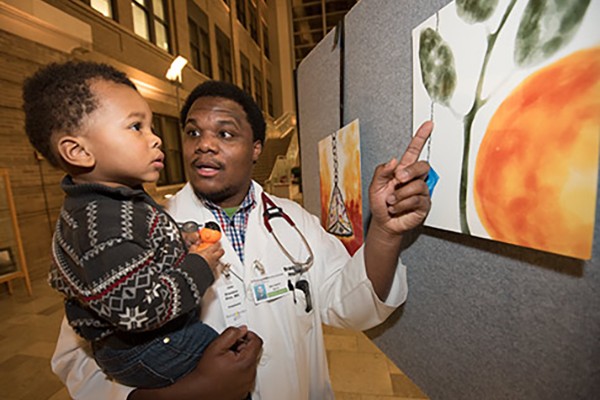
The School of Medicine’s 11th Annual Art Show is underway in the Farrell Learning and Teaching Center atrium on the Medical Campus. Visitors may view the art through Feb. 11.
View More Stories