
Protein that rouses the brain from sleep may be target for Alzheimer’s prevention
A protein that stimulates the brain to awaken from
sleep may be a target for preventing Alzheimer’s disease, a study by School of Medicine researchers suggests. David M. Holtzman, MD, head of the Department of Neurology, is the study’s senior author.
Washington University Dance Theatre Dec. 5-7
Five young women take the stage, playful but competitive. In “Fandango” (1963), Antony Tudor explores the nature of friendly rivalries with energy and insight. In December, “Fandango” will be among seven professionally choreographed works featured in “emBodied Language,” the 2014 Washington University Dance Theatre concert.
Rhodes Scholar finalist Louisa Kornblatt blends passion with compassion
Washington University in St. Louis alumna Louia Kornblatt, a finalist for a 2014 Rhodes Scholarship, is working to help women overcome gender-based violence and find their voice.
Hawkins named chief of hepatobiliary-pancreatic and GI surgery
William Hawkins, MD, a noted pancreatic cancer surgeon, has been named chief of the Section of Hepatobiliary-Pancreatic and Gastrointestinal Surgery, and the Neidorff Family and Robert C. Packman Professor at the School of Medicine.
Damage to brain networks affects stroke recovery
Initial results of an innovative study may significantly change how some patients are evaluated after a stroke, according to School of Medicine researchers. Shown is the study’s senior author, Maurizio Corbetta, MD.
Department of Classics to launch new doctorate
The Department of Classics in Arts & Sciences will launch a new Doctor of Philosophy in classics next fall. The program builds on the department’s nationally recognized Master of Arts but also draws on resources from across the university to create specialized tracks in ancient performance, ancient history, ancient philosophy and Greek and Roman music.
Racist hate network using media to sabotage immigration reform, says book author
As immigration reform once again heads to the
front-burner of American politics, the nation’s politicians and voters
have an opportunity to decide whether a fringe coalition of racist
groups will once again be allowed to sabotage serious efforts to reach a
rational compromise on critical immigration issues, suggests Robert W. Sussman, author of a new book on enduring scientific myths behind modern racism.
Exploring the genomes of mice and men
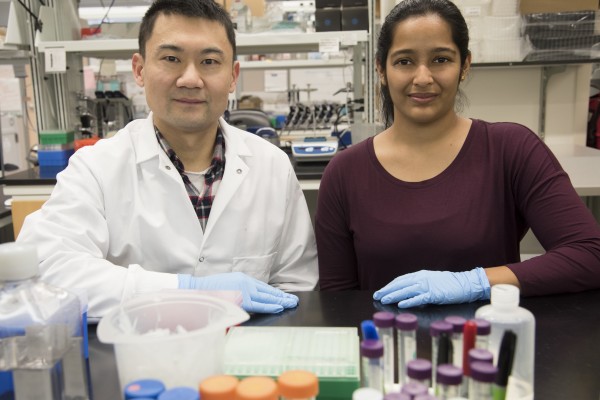
New research by Ting Wang, PhD, (left) and graduate student Vasavi Sundaram has uncovered some striking differences in the genomes of humans and mice that can help scientists determine when a mouse may be a good stand-in to study human biology and disease.
Wall recognized for work at Ethiopian university
L. Lewis Wall, MD, DPhil (right), has received a gold medal for his “meritorius contributions” to medical education at Mekelle University College of Medical and Health Sciences in Mekelle, Ethiopia. He is a professor of obstetrics and gynecology at the Washington University School of Medicine and of anthropology in Arts & Sciences.
New treatment for Marfan syndrome shows promise
An investigational treatment for Marfan syndrome is as effective as the standard therapy at slowing enlargement of the aorta, the large artery of the heart that delivers blood to the body, according to a new study co-authored by Alan C. Braverman, MD. Slowing aortic growth in Marfan syndrome is important in protecting against the tearing of the aorta.
View More Stories