
Valeri installed as the Reverend Priscilla Wood Neaves Distinguished Professor of Religion and Politics
Mark Valeri, PhD, widely regarded as one of the most eminent scholars of American religion during the Revolutionary War era, was installed Feb. 24 as the Reverend Priscilla Wood Neaves Distinguished Professor of Religion and Politics.
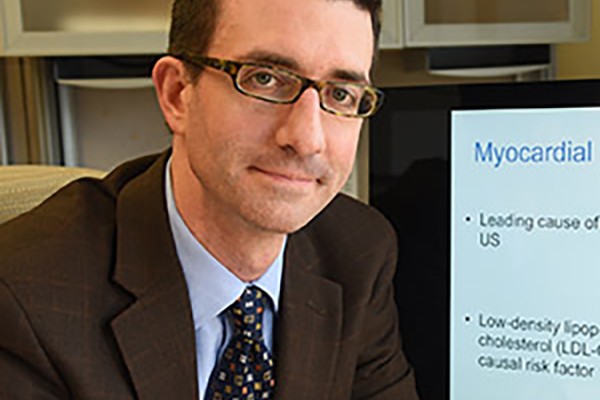
Study shows who benefits most from statins
New research suggests that widely used statin therapy provides the most benefit to patients with the highest genetic risk of heart attack. Using a relatively straightforward genetic analysis, the researchers, including Nathan O. Stitziel, MD, PhD, assessed heart attack risk independently of the traditional risk factors.
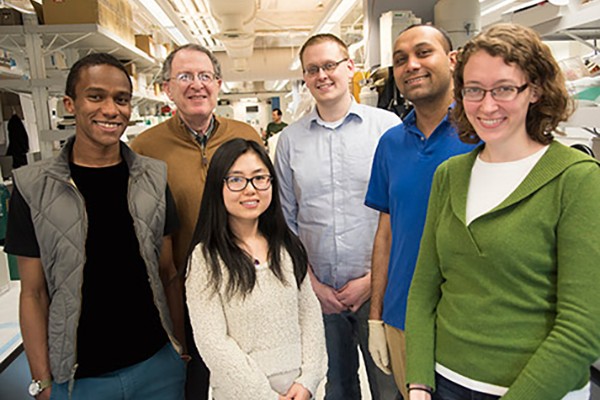
Gordon awarded King Faisal International Prize in Medicine
Jeffrey I. Gordon, MD, director of the Center for Genome Sciences and Systems Biology, has been awarded the King Faisal International Prize in Medicine.
Washington University Libraries launches faculty survey March 3
Washington University in St. Louis faculty on the Danforth Campus are invited to complete a survey about resources and services offered by Washington University Libraries. The survey will help the libraries better develop, enhance and deliver the collections and services designed to meet the current and future needs of the campus community.
New target identified in fight against Alzheimer’s, multiple sclerosis
Highlighting a potential target in the treatment of
multiple sclerosis (MS) and Alzheimer’s disease, new research suggests
that triggering a protein found on the surface of brain cells may help
slow the progression of these and other neurological diseases.
MEDIA ADVISORY: Washington University, Wells Fargo Advisors celebrate community partnership March 3
What: Washington University and Wells Fargo Advisors (WFA) present “Innovate, Accelerate, Transform: Investing in People, Businesses and Communities,” an event showcasing the beneficial results of their unique community partnership. When: 3:30 p.m.-6 p.m. Tuesday, March 3. Where: Washington University’s Danforth Campus, Knight/Bauer Hall campus map Who: Washington University students, faculty and alumni, as well as […]
Segregation, social justice and the American Bottom
The Center for the Humanities and the Sam Fox School of Design & Visual Arts have announced the first recipients of Faculty Collaborative Grants. Presented under the auspices of The Divided City, a new urban humanities initiative, the awards are funded in part by a four-year grant from the Andrew W. Mellon Foundation.
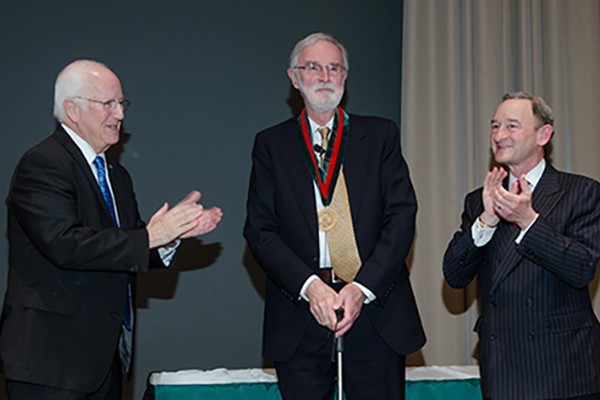
Raichle named Wolff Distinguished Professor of Medicine
Marcus E. Raichle, MD, has been named an inaugural Alan A. and Edith L. Wolff Distinguished Professor of Medicine at the School of Medicine. A professor of radiology, psychology, biomedical engineering, neurobiology and neurology, his many honors include the 2014 Kavli Prize for Neuroscience.
St. Louis Symphony musicians present ‘Bosnian Journeys: Generations’ March 3
Since the mid-1990s, thousands of Bosnian refugees have settled in South St. Louis. Today, “Little Bosnia’ includes more than 60,000 people — the largest Bosnian community outside Bosnia. On Tuesday, March 3, the Department of Music and musicians from the St. Louis Symphony will explore their stories with a free concert titled “Bosnian Journeys: Generations.”
Skinker Boulevard brighter thanks to new pedestrian lamps, improved street lights
Things are looking much brighter on Skinker Boulevard between Forest Park Parkway and Delmar Boulevard, thanks to Washington University’s installation of new pedestrian-scale lighting and improvements to the street lighting.
View More Stories