Beware the smell of bitter almonds
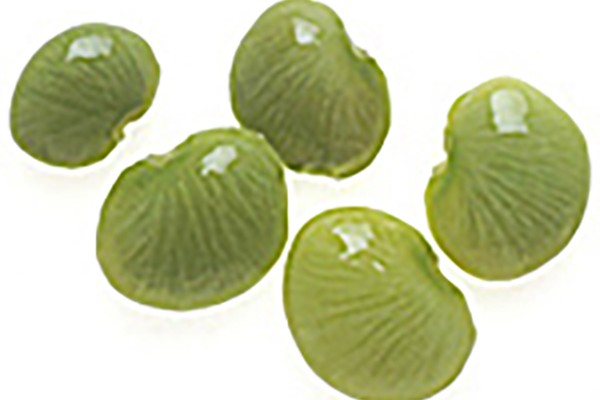
Many food plants contain cyanogenic glycosides that can release cyanide when the food is eaten. What’s more, a greater proportion of food plants than plants in general are cyanogenic. WUSTL researcher Kenneth M. Olsen, PhD, offers an explanation of this toxic puzzle.

A sobering demonstration
Occupational therapy students learn the powerful effect of alcohol on an egg to demonstrate fetal alcohol spectrum disorder.
Volvox genome sequenced
Scientists have sequenced the genome of the colonial alga, Volvox carteri, the journal Science announced. While the photosynthesizing colonial algae is fascinating in itself, knowing its genome may also help scientists engineer algae able to produce economic biofuels.
Math, science focus of two-week residential summer camp at WUSTL for St. Louis-area middle schoolers
Washington University is hosting its fourth ExxonMobil Bernard Harris Summer Science Camp June 20-July 2 for 48 middle school students from St. Louis City, County and Metro East schools. The free two-week residential camp offers innovative programs to enhance middle school students’ science and math knowledge. Former NASA astronaut and camp namesake Bernard A. Harris Jr., MD, will visit the campers from 10 a.m. to noon June 30 in Holmes Lounge, Ridgley Hall.
What plant genes tell us about crop domestication
Archeobotanists argue that plant domestication involved much trial and error in many different geographic regions over a long period of time. A genetic technique that allows domesticated and wild strains of the same plant to be compared shows that domestication requires only simple genetic changes. Yet the findings don’t contradict the archeobotanical data.
Reaching for the stars
Former astronaut and camp founder Bernard A. Harris Jr., MD, visits the ExxonMobil Bernard Harris Summer Science Camp held at Washington University June 20-July 2. Harris helped the 44 middle school campers from St. Louis-area schools with a hands-on engineering challenge. The free residential camp gives students the opportunity to get ahead in math and science, meet inspiring role models and experience college life.
Agarwal recognized for contributions to green aviation, engineering education
Ramesh Agarwal has won a series of awards this past year both for his work in green aviation (using computational fluid dynamics and flow control to increase the energy efficiency of airplanes, trucks and wind turbines) and for his tireless devotion to teaching and mentoring engineering students.
A tribute to Owen Sexton
Friends and colleagues of Owen Sexton, PhD (right), professor emeritus of biology in Arts & Sciences and former director of Tyson Research Center, joined him June 17 at the facility to thank him for his mentorship and for advocating the purchase of the research center, WUSTL’s 2,000-acre field station in the Ozark foothills 20 miles outside of St. Louis.
Solving the puzzle of the BK ion channel
A team of scientists at Washington University has discovered that an ion-channel mutation that causes epilepsy may do so by making part of the channel protein stiffer, so that the channel toggles open more easily. This is the first time that protein dynamics have been implicated in the functioning of an ion channel.
Memory links to 40 winks
When it comes to executing items on tomorrow’s to-do list, it’s best to think it over, then “sleep on it,” say psychologists at Washington University in St. Louis. The researchers have shown that sleep enhances our ability to remember to do something in the future, a skill known as prospective memory.
Older Stories