
Olin Business School honors distinguished alumni
Olin Business School feted four of its top alumni during the 2014 Olin Distinguished Alumni Awards Dinner March 4 at the Ritz-Carlton in Clayton. The school presented four Distinguished Alumni Awards, the Dean’s Medal and the Olin Award, which recognizes the important impact scholarly research can have on business results.
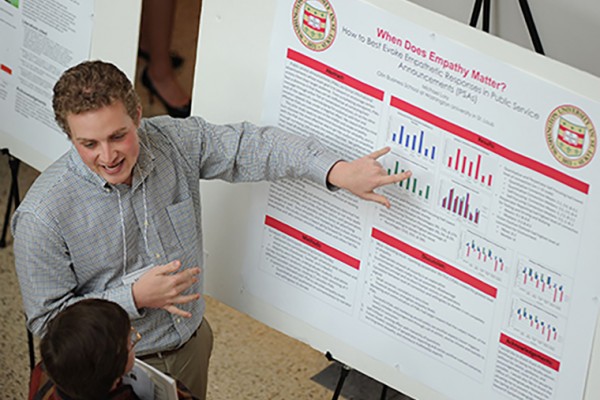
Displaying depth, breadth of undergrad research
More than 170 Washington University in St. Louis undergraduates showcased their research projects through poster, visual and oral presentations during the 2014 Spring Undergraduate Research Symposium, held April 28 in Bauer and Knight halls.
Four myths about privacy
Many privacy discussions follow a similar pattern, and involve the same kinds of arguments. It’s commonplace to hear that privacy is dead, people — especially kids — don’t care about privacy, people with nothing to hide have nothing to fear, and privacy is bad for business. “These claims are common, but they’re myths,” says Neil M. Richards, JD, privacy law expert and professor of law at Washington University in St. Louis.
Dining-Out military event held at Olin
Retired Lt. Gen. George J. Flynn, who served as deputy commandant for combat development and integration for the U.S. Marine Corps, makes a point during his remarks at a formal Dining-Out event April 17 in the Knight Center. Sponsored by the Olin Veterans Assocation, the Dining-Out event is a formal military tradition for members of a company or other unit aimed at fostering camaraderie.
Board diversity a ‘significant opportunity’ for corporations
The number of women and minorities on corporate boards has remained static in the last 10 years, despite an increasing amount of data supporting the argument that board diversity is related to good business outcomes. “Businesses have a significant opportunity to improve performance through increasing the diversity – in many forms – of their board,” said Hillary Sale, JD, corporate governance expert and professor of law and management at Washington University in St. Louis. Sale offers thoughts for both corporations and potential board candidates.
Leading change from the middle
In his new book, “Leading Change from the Middle,” Jackson Nickerson, PhD, the Frahm Family Professor of Organization & Strategy in Olin Business School at Washington University in St. Louis, offers a practical and novel approach for building extraordinary capability without the traditional use of authority.
Annual innovation competition winners named
The ninth annual YouthBridge Social Enterprise and Innovation Competition has announced the year’s winners and its $155,000 in awards. Winning teams represented community and Washington University in St. Louis social entrepreneurs. Their social venture ideas ranged widely, covering youth, teens, education, science
and more.
Brookings descendant visits campus
John Wallace, Robert S. Brookings’ great-grandnephew, talks with Tenille Washburn (JD ’01), a student in the Brookings Executive Education (BEE) program, before a dinner at the Knight Center March 31. With Wallace is his wife, Ellen Wallace (right). The Wallaces were in town for a BEE conference on Daring to Lead. Robert S. Brookings was president of the Washington University in St. Louis Board of Trustees from 1895 to 1928.
Washington University nets $3.4 million energy grant
Carbon dioxide, which enters the atmosphere through the burning of coal and other fossil fuels, is a significant contributor to U.S. greenhouse gas emissions. Last year, President Barack Obama proposed a sweeping climate action plan to mitigate the impacts of climate change. Washington University in St. Louis, a leader in advanced coal research and technology, will be contributing to the president’s plan with research funded by a $3.4 million grant from the U.S. Department of Energy.
Time to celebrate
Olin Business School celebrated its 97th birthday March 28 with barbecue, arcade games and fun in the school’s newly opened Knight and Bauer halls. Pictured is Olin employee Nate Quest.
Older Stories