
New technology focuses diffuse light inside living tissue
Lihong Wang, PhD, continues to build on his groundbreaking technology that allows light deep inside living tissue during imaging and therapy. In the Jan. 5 issue of Nature Communications, Wang, the Gene K. Beare Professor of Biomedical Engineering at Washington University in St. Louis, reveals for the first time a new technique that focuses diffuse light inside a dynamic scattering medium containing living tissue.
Online coin and currency research tool to be established at Washington University
Washington University in St. Louis and the Eric P. Newman Numismatic Education Society (EPNNES) have announced plans to create the Newman Numismatic Portal, an online research tool that will become the ultimate go-to resource for the study of coins and currency. A commitment of $2 million from EPNNES will support the project.
Middle School Summer Challenge new program for area middle school students
A new summer program targeting sixth-, seventh- and eighth-graders will be available in the summer of 2015. The Middle School Summer Challenge combines advanced coursework in a range of academic interests with leadership development designed to provide participants with a complete scholastic and social experience.
Blasingame honored by Association of Fundraising Professionals
One of Washington University’s own received special acknowledgement from the St. Louis Chapter of the Association of Fundraising Professionals. In a ceremony held Nov. 13, David Blasingame, executive vice chancellor for Alumni & Development Programs, was given the association’s Lifetime Achievement Award for his dedication and long-running success.
Friedman engages Wash U students
Before delivering the keynote address at Washington University in St. Louis’ Founders Day celebration Nov. 8, prolific author and journalist Thomas L. Friedman visited with students on the Danforth Campus. Friedman, the popular columnist for The New York Times known for his sophisticated analysis of complex issues facing the world, engaged students in a lively discussion.
Improving imaging of cancerous tissues by reversing time
Lihong Wang, PhD, the Gene K. Beare Distinguished
Professor of Biomedical Engineering at the School of Engineering &
Applied Science is applying a novel time-reversal technology that allows
researchers to better focus light in tissue, such as muscles and
organs.
Mosaic Project concludes
For the past year and a half, dedicated students, faculty and staff have come together through the university’s Mosaic Project to help move us toward a more inclusive campus community. Now, as this initiative is concluding, the efforts of the eight Mosaic Project working groups are taking root at the university.
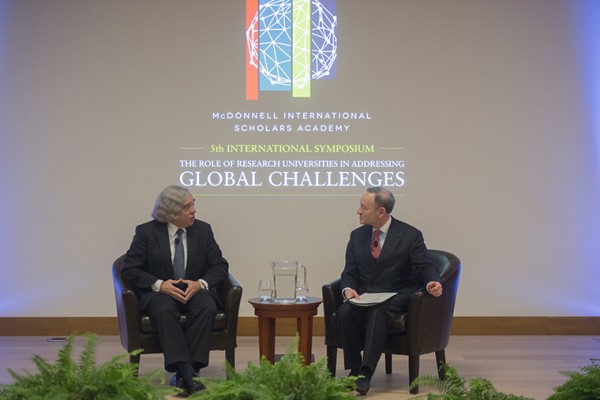
Addressing global challenges: The role of research universities
Representatives and leadership from Washington University and the 28 McDonnell International Scholars Academy institutions came together with policymakers, researchers, students and corporate partners for the recent Fifth International Symposium on “The Role of Research Universities in Addressing Global Challenges.” The symposium, sponsored by the McDonnell Academy, focused on how interdisciplinary research and education collaboration can lead to innovative solutions for the world’s most pressing problems
Walk through buildings from your own device
The School of Engineering’s Yasutaka Furukawa, PhD, combines 3-D computer vision of indoor scenes
with the capabilities of Google Maps and Google Earth to create a
unique, high-resolution, photorealistic mapping experience of indoor
spaces. Though he is starting with spaces like the New York museum The Frick Collection, he intends to bring his technology to St. Louis — specifically to
Washington University’s Danforth Campus.
Washington People: Mark Rollins
For Mark Rollins, PhD, professor of philosophy and chair of the Performing Arts Department (PAD), both in Arts & Sciences, a guiding principle throughout his distinguished career at Washington University in St. Louis has been making connections in the search for answers. This principle has proved useful in his administrative work for the university and as an educator and researcher whose focus is on making connections between science and art.
View More Stories