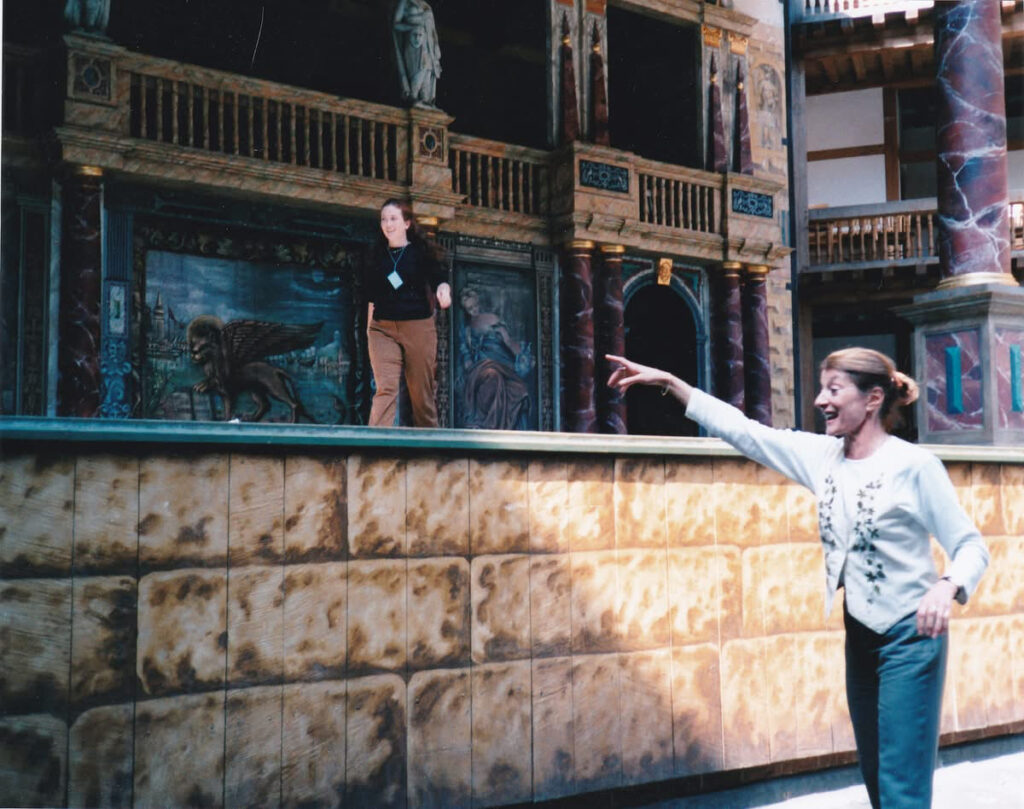
WashU lost a dear and loyal friend when it was announced that the celebrated Tony-Award winning actress Jane Lapotaire had died at her London home March 5 at the age of 81.
Ms. Lapotaire, who was an honorary associate artist at the Royal Shakespeare Company and began her acting career with Laurence Olivier’s National Theatre Company (she played the role of Shylock’s daughter Jessica to Olivier’s Shylock in 1970), had only recently received the award of CBE (Commander of the Order of the British Empire) and attended her investiture at Windsor Castle in February 2025 just weeks before her death. Among many prestigious acting awards, she received both the Olivier and Tony Awards for her portrayal of French singer Edith Piaf in “Piaf” in 1981.
Ms. Lapotaire was not only a legendary and extraordinarily versatile actress, she was an accomplished writer, and published several books, including “Everybody’s Daughter, Nobody’s Child” (1989), a memoir about her childhood born out of wedlock to a French teenager (she surmised that her real father was an America GI), and “Time Out of Mind” (2003), a memoir about the cerebral hemorrhage which nearly ended her life and threatened to prematurely end her acting career.

In a career that spanned more than five decades, Jane played nearly every major female lead in the classical repertoire, including Viola in “Twelfth Night,” Rosalind in “As You Like It,” Joan in “St. Joan,” Katherine in “Taming of the Shrew,” Jocasta in “Oedipus,” Maria Callas in “Master Class,” and Lady Macbeth in “Macbeth.” More recently, she took on more mature Shakespearean roles, from Gertrude in Kenneth Branagh’s stage production of “Hamlet” to the Duchess of Gloucester in David Tennant’s “Richard II.” Although her great love was the theatre, her career included numerous roles in film and television. She first came to the attention of the wider public as the eponymous heroine in the BBC mini-series “Madame Curie” (1977), and later had significant roles in such international successes as “Downton Abbey” and “The Crown.”
Ms. Lapotaire’s unquenchable passion for the theatre, combined with her intelligence and pedagogical skill, also made her a truly legendary teacher. It was in that capacity that many WashU students got to know and love her. She taught as artist-in-residence for an entire semester on several occasions, and participated annually as a special guest artist at WashU’s Shakespeare’s Globe Summer Program from 1993 through 2020.
Ms. Lapotaire’s classes on Shakespeare at the Globe Program were the stuff of legend and inspired countless students to hone their craft. Always demanding, yet loving and compassionate, she offered students an appreciation for text and spoken word from the perspective of one of the greatest Shakespearean interpreters of our age. Asking them to come to class with a prepared speech or sonnet, Jane painstakingly drew students’ attention to the importance and complexity of words and lines, noting how important antitheses were in interpreting the text, and that by responding to apparently miniscule but pivotal moments in the text, not only stage delivery but memorization and even stage movement all became easier and more natural. Her students emerged from her classes revitalized and suddenly realized that they no longer found Shakespeare’s language difficult or tedious. Now the lines of the text were exciting and brimming with vibrancy.
I had the good fortune to hire Jane back when she was president of the Friends of the Globe Theatre in the early 1990s. She taught at WashU’s summer theatre program virtually every year between 1993 and 2020. While recovering from her cerebral hemorrhage in 2003, Jane chose to recuperate by staying with my wife Patty and I at our home on Pershing Place in St. Louis’ Central West End. She lived with us for several months in our spare room and essentially became a member of our family. I recall my youngest daughter waking her up in the middle of the night to announce that the cat was in the process of delivering a litter of kittens in our bedroom closet. Jane rushed down in her bathrobe to be present for the occasion, and the utter joy she felt as kitten after kitten emerged was unforgettable. She developed a particular friendship with my late wife Patty, and saw her as someone who helped her emerge from this terrifying and deadening episode in her life when she thought her career was over. In a dedication in her copy of “Everybody’s Daughter, Nobody’s Child,” Jane inscribed “To my very dearest Patty, who knows all there is to know about being a mother.”
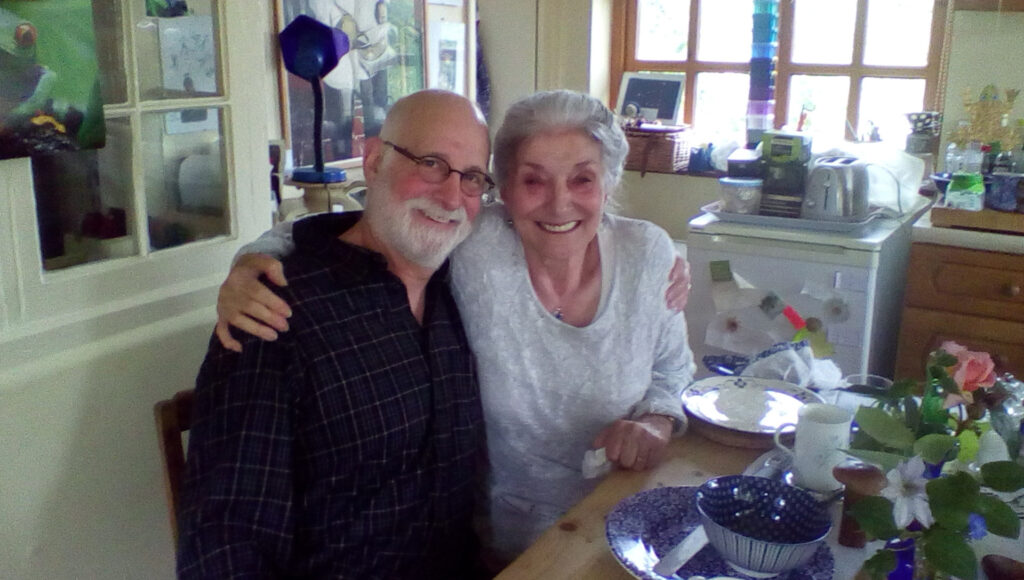
It is not an exaggeration to say that Jane’s extended “family” embraced her many students at WashU, whether on campus in St. Louis or at the Globe. The great number of students whose lives she impacted during those decades will forever remember the powerful influence of her formidable presence in the classroom, regardless of whether they continued acting professionally. When she lived and taught here in St. Louis, Jane delighted in long walks through Forest Park and exploring the tiny shops in the Central West End. I still recall how she pronounced the name of the local upscale grocery store Straub’s (“Strawwb’s”) and how she decorated her room with miraculous little drawings of flowers and birds and presented them to my daughters when she returned to London in renewed health.
Jane’s devotion to her students at WashU was expressed in a plethora of ways. She co-directed Shakespeare’s “Twelfth Night” with me in 2005 (having played Viola at the RSC previously), and I vividly recall our walks to and from the Olin Studios during the rehearsal period and how deeply committed she was to the students in the cast and in their interpretations of the text.
Perhaps Jane’s greatest gift to me personally came just before she boarded the plane to teach for us in St. Louis in 1999. I had called her the night before to check on her time of arrival. During the conversation, Jane asked what I was working on, and when I mentioned I had been commissioned to write a new play (my very first!) for the St. Louis Holocaust Museum to commemorate Yom Hashoa (Holocaust Remembrance Day) in April, she paused momentarily and asked me a strange question: “Is there a part in it for me?” I hesitated, not knowing how to respond.
As a first-time playwright I couldn’t possibly ask this Tony Award-winning actress act in a part in a play I had written, could I? But I answered honestly, and told her that yes, one of the characters in my play, “Hannah’s Shawl,” was a Holocaust survivor named Rachel, who lived in St. Louis with her American husband and young daughter (Hannah) who wanted to explore what happened to her family during the Holocaust. Without hesitation, Jane said she wanted to take the role if it was available, and that she would learn her lines on the flight to St. Louis. I faxed her the script (there was no email then) and by the time she touched down at Lambert Airport, she knew Rachel’s lines cold. I could not believe that this internationally renowned actress was speaking my lines. When the play was performed at Brith Sholom Kneseth Israel synagogue on April 13, 1999, with a student cast and my colleague Bill Whitaker in the role of Jane’s husband, all under the superb direction of Anna Pileggi. I cannot describe the thrill I felt at the gift Jane had bestowed not only upon me, but also upon the St. Louis and WashU communities.
Since my wife’s passing and my subsequent retirement from WashU in 2024, Jane and I have seen less of one another. However, I wrote to her in late January with some good news about our Shakespeare’s Globe Program (to which she had contributed so significantly over many years). In an email that I received just weeks before her passing, Jane wrote; “I can honestly say hand on heart that my times in St. Louis were the happiest of my life. Much love and gratitude, Janie.”
With her passing, the world has not only lost a truly magnificent theatrical talent. WashU has lost a wonderful teacher and treasured friend.
Henry Schvey is professor emeritus of drama and former chair of the Performing Arts Department in Arts & Sciences.