W
hen Mark West was a high schooler one summer in Nashville stocking vending machines and mulling over his future, he remembers thinking that it’d be cool to be a multilingual translator at the United Nations, to know all the languages so as to be the one who could help make diplomatic connections across numerous aisles.
“Maybe an overly aggressive ambition,” he says, laughing. “Once I got to college, I learned pretty quickly that not only was it likely not a job that existed, it was also something I probably couldn’t pull off.”
But he loved language, and so he figured he’d find the most off-the-beaten-path, entry-level language class in the Rhodes College course catalogue at the time, and that turned out to be Japanese. He ended up in a class with only a handful of curious students, with a visiting instructor who taught psychology at a Japanese women’s college and had limited English skills. West recalls that he and his cohort had no choice but to speak Japanese from day one.
“She was trained and highly skilled in pedagogy, but not Japanese language pedagogy,” West says. “She didn’t have a sense for how much was too much, and neither did we. We were kids! So when this wonderful instructor, who we all thought the world of, said, ‘I need you to learn 100 characters by the end of the week,’ we thought that was just as normal as our textbook, which was entirely in Japanese. We pushed ourselves to meet her expectations.”
By the end of that academic year, West and his classmates were well on their way to fluency. His experience in that classroom would prove foundational to his entire career, where West, now provost and executive vice chancellor for academic affairs at Washington University in St. Louis, is one of the country’s leading scholars of the Japanese legal system.
West, a prolific writer, teacher and academic administrator who spent more than two decades at the University of Michigan before coming to WashU, understands inherently that storytelling is a unique way to take complex concepts — from languages to law to higher education administration — and break them down into understandable, and actionable, parts.
“The one thing we can all relate to are stories,” he told a packed crowd last month in Graham Chapel, speaking for the Assembly Series during his first public lecture as provost. “And we can use law to understand a country’s systems — and stories.”
“The one thing we can all relate to are stories.”
Mark West
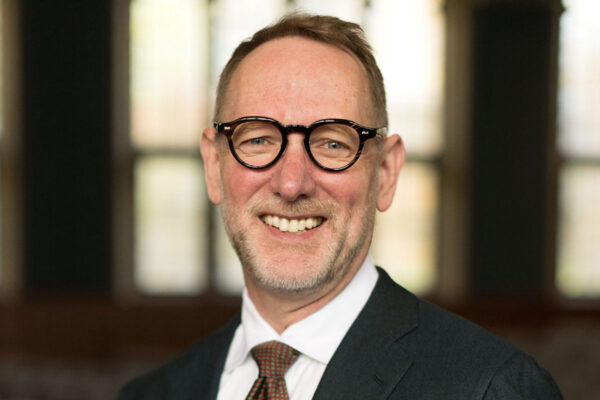
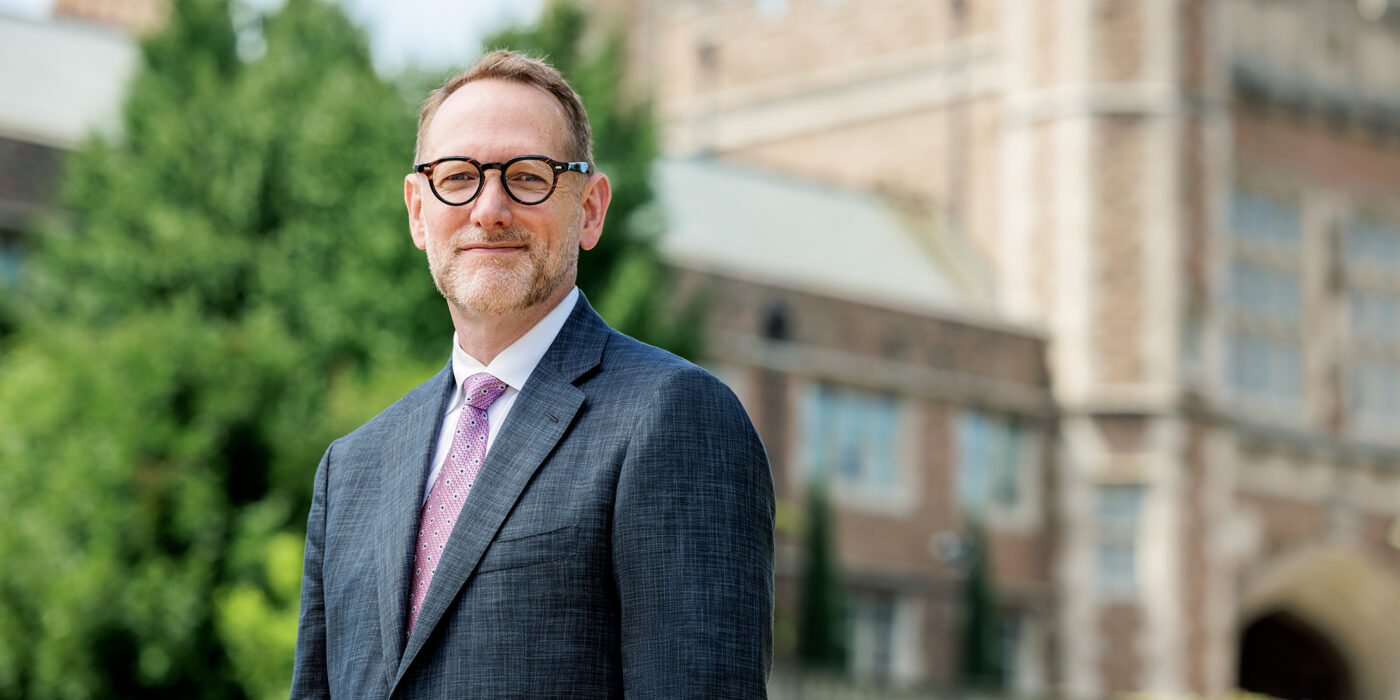
After earning a bachelor’s degree from Rhodes College in international studies and then his JD from Columbia University, West spent his early career working as a corporate lawyer, focusing largely on transactions that involved Japanese multinational companies and splitting his time between New York and Tokyo. In 1998, he joined the faculty at the University of Michigan Law School and founded the Japanese legal studies program there. Five years later, he had an endowed chair and was director of the University’s Japanese Studies Program, Five years after that, he was appointed associate dean for academic affairs, and five years after that, in 2013, he became the 17th dean at Michigan Law School, a post he held for 10 years plus a semester – a semester he was asked to serve beyond the university’s ten-year term limit. He stayed in Ann Arbor as the Nippon Life Professor of Law and was happily working on his seventh book before accepting the role of WashU provost, beginning his service on August 1.
Since then, it’s been a whirlwind, but West and his wife, Amber, are settling down and getting to know both St. Louis and the campus community. He got to meet many in the WashU alumni community at that Nov. 4 Assembly Series lecture with his talk titled “Life and Love: Systems and Stories — and Japanese Law.”
“Mark has made it easy to build relationships.”
Tonya Edmond
“Mark has made it easy to build relationships,” says Tonya Edmond, the William E. Gordon Professor at the Brown School and chair of the Faculty Senate Council, in introducing him. “He has proactively sought collaboration and has brought with him curiosity, candor, respect, humor, a keen intellect and playfulness to meetings where we were strategizing academic excellence.”
Before that lecture, West sat down with WashU Magazine and talked about the challenges and opportunities facing higher education; his leadership style; and what he’s learning about his new hometown.
What was your first impression of WashU?
Nashville is only a five-hour drive from here, but Missouri wasn’t a part of my world, which I seem to have defined by largely by the places I lived as a child: Arkansas, Virginia, Kentucky, Louisiana, and eventually Tennessee. As a teenager and potential student, all I knew of WashU was that it had a good liberal arts school, which I must have assumed from a course bulletin or something. As my career progressed, I saw increasingly more of WashU’s strengths, and formed strong relationships with many people who have deep ties to the university. Now, I see WashU as an academic powerhouse ready to erupt, so that makes it extraordinarily exciting to be here. Higher ed is being challenged in unprecedented ways, but to me, this is the most invigorating time to lead the faculty of one of the most fascinating institutions in all of higher education.
How are you dealing with the unique challenges 2025 has thrown at higher education?
First of all, I feel surprisingly prepared, a development I credit to two decades at a large, very complicated, very public university. WashU is different along many dimensions, but I realize now that I learned quite a bit working though some of the difficult issues that I faced. It’s not that the challenges at WashU aren’t daunting, because they are. It’s not that I have no concerns, because we all do. I am simply pleased to see that nothing feels especially foreign, and the fact that every single person I meet loves our home gives me great comfort and optimism for our shared future.
Still, we are addressing many challenges. The place where the rubber hits the road for me is where our resources connect with our highest vision of academic excellence, and those two things need to be closely aligned. So when we come up with fantastic new ideas — and we have and we will — we need to make sure that we have the resources to implement them. And then, conversely, when we have resources to implement, we need to employ those resources to do cutting-edge work, create knowledge, serve the world and push WashU to top of mind for everyone, and I mean everyone, in higher education. If we can align resources and ideas, we will succeed.
What are the opportunities for WashU in this current climate?
What will propel us to the next level is first-rate, impactful research. It’s not the only way, and it’s certainly not the only thing that matters, but everything else follows — including those rankings that often are so important to prospective students. We have some areas of campus that are thriving and others that aren’t to the same degree. It’s my job, and my team’s job, to help everyone thrive to the greatest extent possible, even in a time of difficult resources.
What is your leadership style?
I’m a fan of people and process. Most of the time, people in our corner of the world enjoy community and collaboration, so the job of a leader is to ensure that people can flourish in their roles as we work together. People are also unpredictable, and I find some comfort in having policies and procedures that ground us in some level of commonality, but not too much, as people often can be delightfully unpredictable. I also love learning from the people I work with. I’ve already learned so much from people here, not just about how we do things, but about the way people here think about things, the way ideas are generated and the way knowledge is created. All of this is information that is going to help me in my primary mission: to serve.
What do you aim to be one of the hallmarks of your tenure here at WashU?
I’m looking forward to some bold initiatives that have begun to flow from my conversations with our community. But right now, today, rather than looking for hallmarks, especially in this difficult time we’re facing, it’s important that we also prioritize personal relationships. Every person I’ve talked to has been so kind and willing to engage in conversation. You love WashU! When you can start with that foundation, it’s easy to work on how we can improve together. But you don’t get to those conversations unless you invite the human element into the room and know faculty members by name instead of a title or as a human representation of their CV. I’d much rather be “Mark” than “Provost West.”

Quick hits with Mark West
About six weeks after West arrived in St. Louis, we asked him about his new hometown, the campus and other personal favorites.
Favorite St. Louis neighborhood: Central West End. My wife and I live there now, and we love the energy of it.
Favorite St. Louis restaurant: We don’t really have one yet. Everyone says this is a ‘foodie’ city, but there are only a few things I’m actually a ‘foodie’ about. I’m a work in progress.
Favorite St. Louis attraction: Forest Park. I think we’ve only seen about 10 percent so far, which means we haven’t really even begun to explore it. I’m excited to see the Missouri History Museum.
Favorite spot on campus: I have two, but I want to keep that secret.
Favorite St. Louis sports team: The 1974-76 Spirits of St. Louis. When I was a kid, my dad took me to Kentucky Colonels games in the old American Basketball Association league, and the Spirits were my team, probably because of Moses Malone, but that might be something my brain invented in retrospect so I could make sense of it. That’s the only St. Louis sports team I’ve ever followed closely.
Favorite non-St. Louis sports team: Right now, there is no professional team more fun to watch than the Detroit Lions.
Frozen custard or ice cream? I don’t think I’ve been here long enough to make that momentous decision, but I do really like Clementines.
Toasted ravioli or pasta the old-fashioned way? Toasted. Had it for the first time last August. Easily better than regular ravioli.
Morning person or night owl? I have always thought that I’m a night owl, but every health gadget tells me I’m not, so I have to face the possibility that I might just a big baby who wants to stay up late at night because he’s afraid he might miss something. But I’m gradually becoming more of a morning person.
Favorite novel: I’m not sure I have a favorite, but I find myself thinking often about The Sense of an Ending, the Booker Prize-winning novel by Julian Barnes; and The Wind-Up Bird Chronicle by Haruki Murakami.
Favorite movies: Christopher Nolan’s Inception and Quention Tarantino’s Once Upon a Time in Hollywood are up there, and I like their other films, too. I also have some pleasures that feel even more guilty: Pitch Perfect, Bring It On, and I’ve probably memorized Kings of Comedy by now. And although it’s nowhere near my favorite, I’m one of the few people who thought Joker: Folie a Deux was great, and I’m happy to lose that argument if anyone wants to have it.
Best advice he’s ever heard: I don’t know that I can say what’s the best, but I can tell you what struck me recently that was quite helpful. Yesterday I was prepping for a meeting and someone overheard me kicking myself over something I wish I had done differently. She said, ‘You really should give yourself some grace.’ And I thought, ‘Grace is exactly the right word.’ Especially because I often struggle with imposter syndrome, the fact that she was able to give me that advice so early in my time here helped me feel a sense of community and belonging. It made me proud to be at WashU.