
Every artist has an origin story. Steven Sater’s is more harrowing than most.
As a WashU sophomore, Sater, AB ’76, awoke to find his off-campus apartment in flames. He raced to the balcony. A door burst behind him. His robe caught fire. Sater jumped and fell three floors, breaking both arms, both wrists and 13 vertebrae. He was badly burned. For months he could barely move.
Sater’s adviser, legendary drama professor Herb Metz, came to visit. “You should really learn Greek,” Metz suggested, knowing of Sater’s love for classical literature. And so Sater did. Hospital staff rigged a page-turning device that Sater could operate with his teeth. He immersed himself in ancient tragedy. He read Homer and Aeschylus and scores of others. “It transformed me,” Sater says. “It became the foundation of my life.”
A chasm of ambiguity
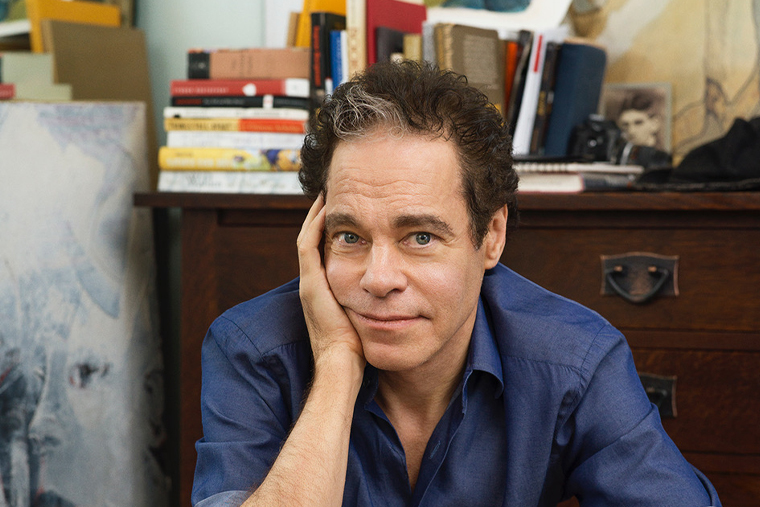
Sater, now a celebrated playwright, would go on to win Tony, Grammy and Laurence Olivier awards. He was among the first guests on the PAD Podcast, which launched in the spring of 2024.
Rob Morgan, teaching professor of drama in the Performing Arts Department (PAD) in Arts & Sciences, hosts the show. Himself an award-winning theater designer, Morgan teaches courses on the nature of creativity. He launched the podcast as a means to celebrate WashU alumni success and to harness their professional expertise.
“A lot of students see post-graduation as an uncertain time — a chasm of ambiguity,” Morgan says. “But our alumni, to use a double-negative, are never not working. They’re busy doing film, television and theater. They have amazing careers.”
Conversations are informal but common themes emerge. What are the challenges of the creative life? What projects are graduates working on? What lessons have they learned?
“The PAD taught me bravery,” says Sasha Diamond, AB ’12, whose credits include recurring roles on CBS’s Tommy and NCIS: New Orleans and Apple TV’s forthcoming Margo’s Got Money Troubles.
“There’s so much structure in schooling,” Diamond says. “‘This is how you succeed.’ ‘This is how you do well.’ When you move into an arts field, that structure goes away. You’re suddenly out there without a net.
“I was so afraid of failing, of doing the wrong thing,” Diamond adds. But PAD faculty pushed her to “get out of the straight-A mindset” and explore her own drives and interests.
If Diamond could offer advice to her college-age self, it would be this: “What are you doing that builds you as a person?” Because that’s what will “bring you happiness and bring you love and bring you joy.”

The best of both worlds
The PAD is a small department, if measured by primary majors. But students from across WashU pursue secondary majors or minors in dance or drama. And scores more take classes, audition for shows and participate in staged productions.
“We offer the best of both worlds: A strong liberal arts foundation and conservatory-style training,” says Julia Walker, department chair and professor of performing arts and English. The dance program, for example, typically includes a substantial contingent of pre-med students. “They’re interested in understanding how the body works, both analytically and experientially,” Walker says.
Pirronne Yousefzadeh, AB ’03, arrived at WashU intending to study medicine and “to do theater for fun.” The plan eventually flipped. During her years as a successful freelance director, “I’ve worked on theater projects that involve neuroscience research,” she says with a laugh.
Today, Yousefzadeh is associate artistic director at The Playwrights’ Center in Minneapolis and a co-founder of Maia Directors, which advocates for artists and stories from the Middle East, North Africa and South Asia. She notes that the simple childhood question “What do you want to be when you grow up?” suggests a straightforward career path.
But more often than not, life is “a circuitous, winding, wicked problem of a path,” Yousefzadeh says. That may feel messy, but one should embrace the journey. “It’s about finding your niche in the world,” she says.
The temple of myth
During his junior year, Manik Choksi, AB ’03, won the role of J. Pierrepont Finch in a campus production of How to Succeed in Business Without Really Trying, the classic Broadway musical.
It’s a great part. Finch is the central character. The story is based on a satirical instruction manual by WashU alumnus Shepherd Mead, AB ’36. There was just one problem. Choksi wasn’t a singer.
In casting him, director Annamaria Pileggi, professor of practice in drama in Arts & Sciences, “took a real chance,” Choksi recalls. And for a moment, “it didn’t look like I was going to get there.” But one day, during rehearsal, Pileggi instructed Choksi to sing the number “I Believe in You” by himself, to himself, while looking into a mirror.
Self-doubt melted away. Suddenly, Choksi felt perfectly aligned with his character. “It was a transformative moment.”
Choksi has since appeared on Succession, New Amsterdam and Unbreakable Kimmy Schmidt, among others. He originated the role of Dolokhov in David Malloy’s acclaimed musical Natasha, Pierre & The Great Comet of 1812, based on Tolstoy’s War and Peace.
More recently, with backing from New York arts hub Ars Nova, Choksi has developed a three-part concert adaptation of the Hindu epic The Ramayana. “If you can imagine Star Wars, the Bible, college basketball and the Lord of the Rings all together,” Choksi says, “this is how ubiquitous The Ramayana is to Indian culture and society.
“My idea is to share this story with the west,” he says, “to invite The Ramayana into the temple of American myths.”
As for the woman who gave him that advice, Pileggi, was a podcast guest herself recently in honor of her final academic year with the PAD.
Things more permanent
For Sater too, classical literature has remained a source of artistic inspiration.
Spring Awakening, his 2006 Broadway smash, won eight Tony Awards and helped launched the careers of stars like Jonathan Groff, Lea Michele and John Gallagher Jr. The musical is based on a 19th century German play by Frank Wedekind but was deeply influenced by Sater’s study of Greek drama. Here, songs function as interior monologues, revealing what characters are otherwise unable to say — a rock spin on the traditional Greek chorus.
Another important influence on Spring Awakening was Irish modernist James Joyce. As a WashU student, Sater had written a long paper on Joyce’s Ulysses, which is famously modeled on Homer’s Odyssey. Sadly, the paper was lost in the fire. And in the days before cloud computing, there was no other copy. The words were simply gone.
Sater took this as another lesson. “I have to bind myself to things that are more permanent,” he remembers thinking. “I want to write things that can last.”
All of these podcasts are available online. To learn more about the PAD podcast and other notable guests, visit https://pad.wustl.edu/pad-podcast