Listen to this story:
As a toddler, Jordan Hughes taught himself to read. In elementary school, he taught himself piano. And at age 21, facing a court date for traffic violations he did not commit, Hughes taught himself the law.
“I found myself a self-help law book and would read 10 pages at a time during my breaks at work,” Hughes recalls. “I don’t know why I thought I could win in court. All I knew is that my record was clean and I was going to fight.”
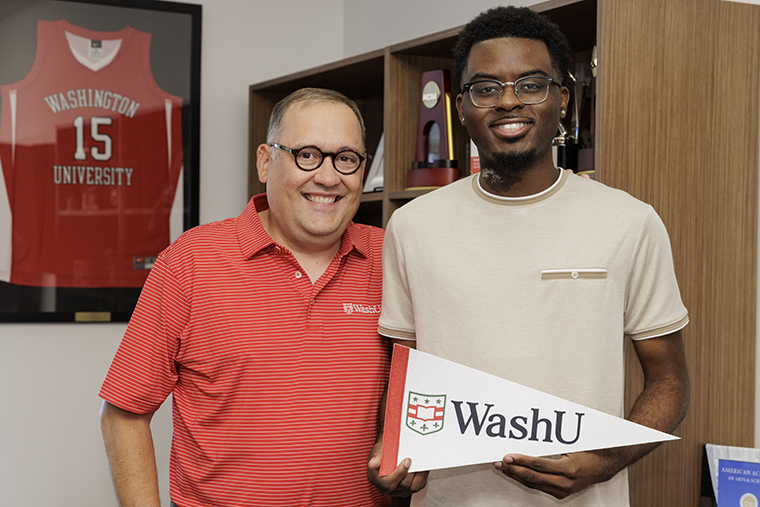
Today, Hughes, 26, is a junior at Washington University in St. Louis — a fact that amazes no one more than him. Just this summer, Hughes was resigned to putting his college dreams on hold. But then in August, Chancellor Andrew D. Martin invited Hughes to his office on the Danforth Campus and presented an astounding offer — an invitation to attend WashU at no cost.
The offer came after Jeff L. Pittman, chancellor at St. Louis Community College (STLCC), told Martin about Hughes’ remarkable journey. Hughes grew up in the Clinton-Peabody Housing Complex, the oldest public housing complex in the city of St. Louis. At age 11, he was the victim of a drive-by shooting, taking bullets to his leg and foot. After a decade of menial jobs and poor grades, he became the first of his 10 siblings to graduate from community college – as class valedictorian, no less.
“I wasn’t giving up on continuing my education, but it was not looking good. I don’t remember what I thought was going to happen when I got to Chancellor Martin’s office, but it wasn’t that. It still feels unbelievable to me.”
Jordan Hughes
At Chaifetz Arena, Hughes delivered a moving commencement address to his STLCC classmates about second chances and the power of education. He had planned to continue his journey at the University of Wisconsin-Madison but realized too late that the university does not offer reciprocal tuition to Missourians.
“I wasn’t giving up on continuing my education, but it was not looking good,” Hughes says. “I don’t remember what I thought was going to happen when I got to Chancellor Martin’s office, but it wasn’t that. It still feels unbelievable to me.”
Arguing his case
Rewind to 2021. That’s when St. Louis prosecutors took Hughes to court for multiple traffic tickets. Hughes explained that his wallet had been stolen and that the thief was the actual culprit. He challenged the memory of an issuing officer and cited studies about unreliable eyewitness testimony. The judge dismissed the case.
“I made a lot of objections, which were usually denied. I guess I read that part of the book wrong,” Hughes recalls with a laugh. “But, in the end, I won. My dad was so proud.”
The bailiff, an older Black man who stood stoically throughout the proceedings, followed Hughes out of the courtroom to congratulate him. He told Hughes that he had never seen a young Black man successfully defend himself.
“It hit me — you hear stories about young men of color being treated unfairly in the legal system all of the time, but it’s another thing to live it,” Hughes says. “For me, it was just about a fine, but for a lot of people, it’s life or death. I realized I needed to go back to school and learn more about the legal system that had been governing me since I was born.”
It would be two years before Hughes began taking classes at STLCC’s Forest Park campus to earn his associate’s degree. Hughes may have loved learning, but he dreaded school. A self-described class clown, he barely graduated from high school and dropped out of another college after a single semester. This time was different. Hughes devoted himself fulltime to his education and surrounded himself with supportive faculty and staff. Ultimately, Hughes was named valedictorian, earning As in every class except one (he’s still angry about that one B) and admission to the University of Wisconsin.
“I didn’t have a perfect past. I didn’t have a clear idea of where I was headed in the future. But I had the present will to try again.”
Jordan Hughes
Still, Hughes didn’t see the point of going to graduation. His 10 siblings convinced him otherwise, and Hughes decided to not only attend commencement but serve as speaker. Before a packed crowd of 10,000 graduates, family members and STLCC faculty and staff, Hughes recounted the shooting that upended his life, the high school principal who lobbied for his expulsion and his belief that all of us are more than our past mistakes and traumas.
“I just hoped that I could be given a second chance,” Hughes told the crowd. “I didn’t have a perfect past. I didn’t have a clear idea of where I was headed in the future. But I had the present will to try again.”
Word got out about Hughes’ inspiring speech and one news outlet after another wanted to interview the shooting-victim-turned-star-student. While talking to the St. Louis Post-Dispatch, Hughes learned he would not be able to attend Wisconsin. Pittman read about Hughes’ plight and called Martin, who promptly dispatched staff members from the Office of Undergraduate Admissions to review Hughes’ transcript and explore aid options.
“This is exactly the type of student we’re looking for,” Martin told the Post-Dispatch in its follow-up story.
Leaning in
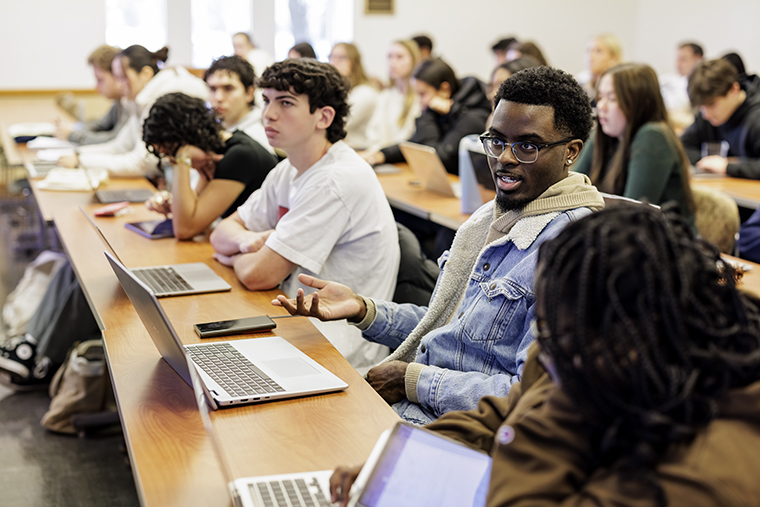
Nearing the end of his first semester at WashU, Hughes is proving the Chancellor right. He is taking classes in political science, economics, psychology and anthropology. The course “Introduction to Chinese Politics,” with Peng Peng, an assistant professor of political science in Arts & Sciences, is his favorite.
“We break into groups and debate policies from both sides,” says Hughes, who is majoring in political science. “It really tests our critical thinking skills and our discussion skills. Those are the classes I love because that’s where my real-world experience comes into play.”
Next semester, Hughes plans to join pre-law student groups to explore research opportunities. He is specifically interested in studying the Cold War-era testing of potential carcinogens at the Pruitt-Igoe Housing Complex, where two of his grandmothers lived.
“One of the main reasons I wanted to come to WashU is to do research,” Hughes says. “There are a lot of people here who can explore that history, but I’m someone who is actually tied to it. I think that would make a difference to the people who I would want to interview.”
Like a lot of WashU students who arrive with a high GPA, Hughes says he has had to adjust to a new level of rigor. Still, he earned As and Bs on most of his midterms, and he remains focused on continuous self-improvement.
“I’ve deleted all of my social media apps from my phone and am going to office hours,” Hughes says. “One of my favorite professors in political science, Michael Strawbridge, gave me great advice. He told me to drop the expectations I put on myself and lean on the resources that the university provides. He told me that I don’t need to be a one-man army. I still want to get all As, but I’m focusing on what really matters — the learning.”